 Reviews
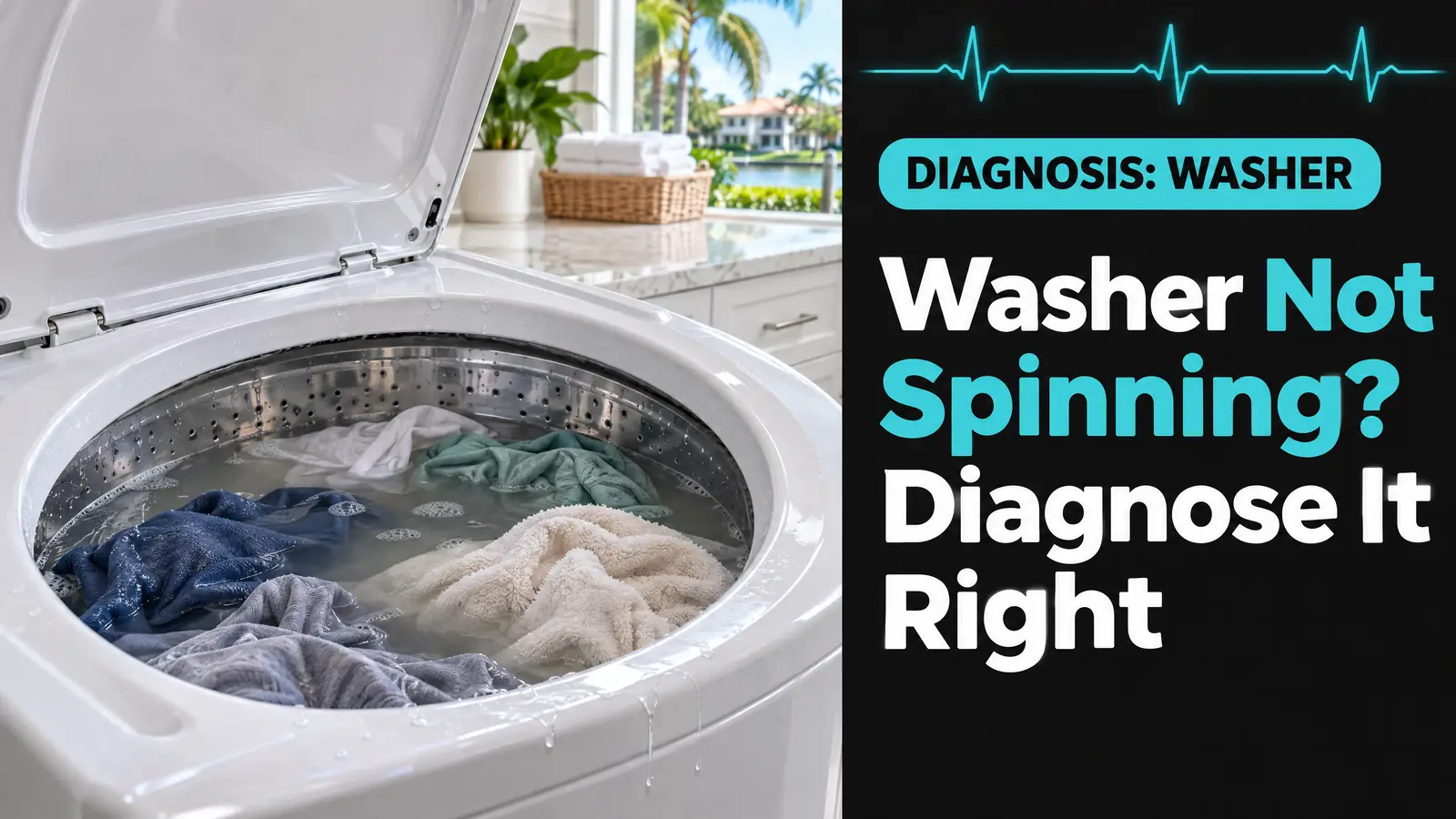
A washer that won’t spin is usually stuck one step earlier: it can’t drain, it thinks the load is unbalanced, or the lid or door lock won’t confirm it’s closed. Less often a worn belt, a broken motor coupling or a failed motor is to blame. Below is how to tell which one you have, the checks you can do safely in about 15 minutes, and what each repair costs if it turns out to be a part.
Quick diagnosis
- Water still in the tub? Treat it as a drain problem first. Samsung’s support team says a washer tries to drain before it spins, and if it can’t drain it never reaches the spin step.
- Tub empty but clothes soaked? Look at the load (one heavy item, or a small load bunched on one side), the spin setting, and suds. Whirlpool says too much detergent can slow or stop the spin.
- Motor hums or runs but the basket doesn’t move? That points to a belt, motor coupling or clutch, which is a technician job.
- Nothing happens at the spin step, no sound at all? Think lid switch, door lock, control board or motor.
- Most spin repairs land between $100 and $400, per HomeGuide.
Triage
- Stop using it now: a burning or hot-rubber smell, smoke, a tripping breaker, or water spreading toward an outlet. Turn it off and unplug it.
- Book a technician: loud grinding or banging, the motor humming while the basket stays still, or a washer that still won’t spin after the free checks below.
- Safe to check yourself: the load, the cycle and spin setting, detergent, the drain hose, a front-loader’s pump filter and leveling.
Symptom checker: what you see and what it usually means
Start with what the washer is doing at the moment it should spin. The same complaint, “it won’t spin”, has very different causes depending on whether there’s water in the tub and whether you hear the motor.
| What you notice | Most likely cause | Who fixes it |
|---|---|---|
| Water left in the tub, no spin | Clogged pump filter, kinked or badly placed drain hose, suds, failed drain pump | You first (filter, hose); technician for the pump |
| Tub drained, clothes dripping wet | Unbalanced or tiny load, Low or No Spin setting, gentle cycle, too much detergent | You |
| Starts to spin, then stops and restarts | Load out of balance, washer not level, worn suspension | You (load, leveling); technician for shocks or rods |
| Motor runs or hums, basket doesn’t turn | Broken belt, motor coupling, clutch or shift actuator | Technician |
| Silent at the spin step, lid or door clicks | Lid switch or door lock not confirming it’s closed | Technician |
| Silent at the spin step, display normal | Motor, motor control or main control board | Technician |
| Loud grinding during the spin it does manage | Tub bearings or a broken drum support | Technician (often a repair-or-replace decision) |
Check these first (no tools needed)
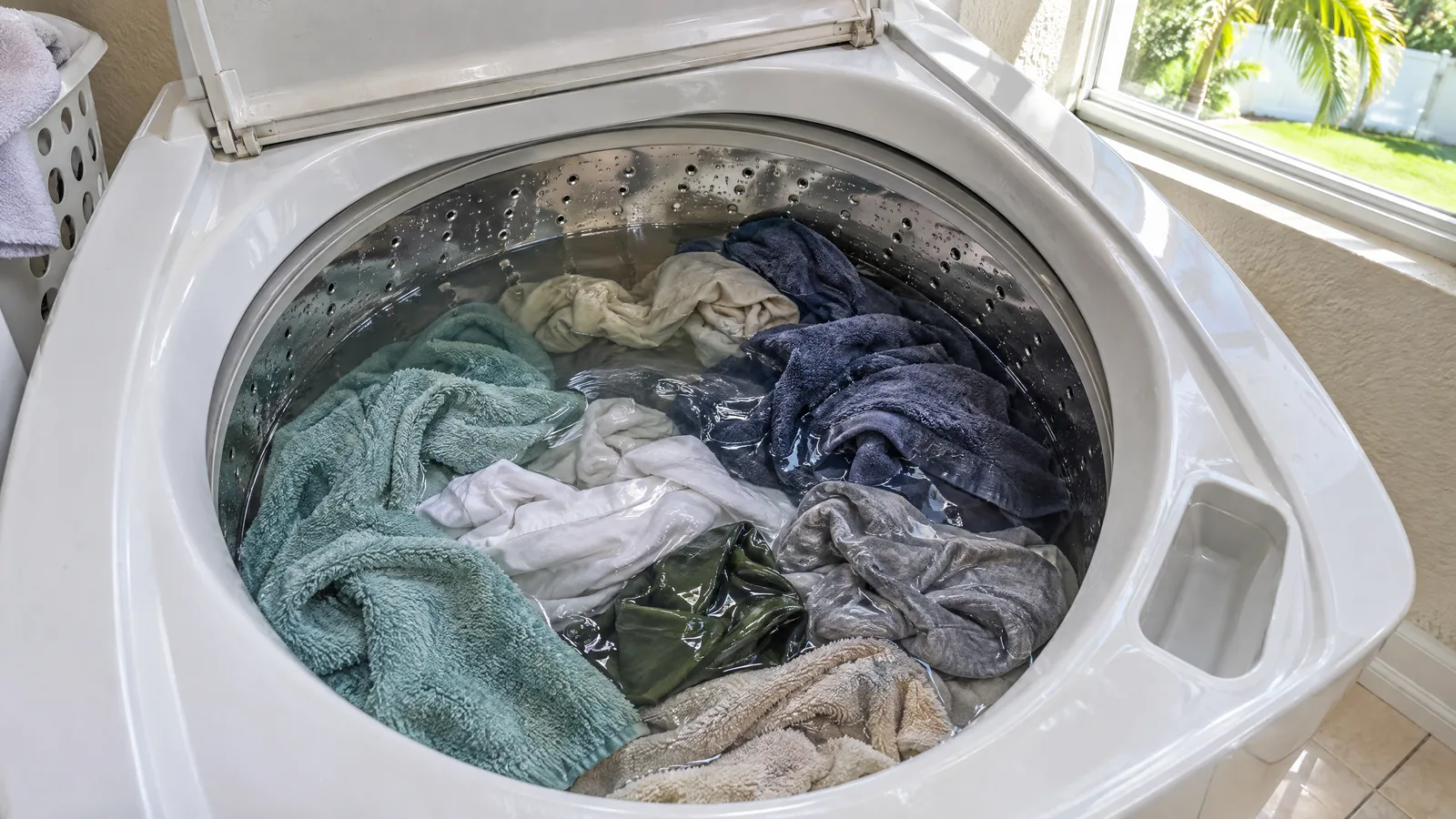
These cost nothing and fix a good share of “won’t spin” complaints. Work through them in this order.
Before you touch anything
- Unplug the washer before you reach into the tub, pull the machine out or open any access panel.
- Never force a locked front-load door or tape down a lid switch. Those locks keep hands out of a spinning drum.
- Drain water may be hot and there may be a lot of it. Have towels and a shallow pan ready before you open a pump filter.
- Look at the load. One bath mat, one comforter or a half-dozen towels bunched on one side will make the washer slow or skip the spin to protect itself. Samsung notes small loads tend to collect on one side, and Whirlpool suggests washing several items rather than a single heavy one. Spread the load out, add a couple of towels if it’s tiny, and run Drain & Spin (or Rinse & Spin).
- Check the spin setting, not just the cycle. Delicate, hand-wash and gentle cycles spin slowly on purpose and leave clothes wetter. Whirlpool also points out that its washers remember settings per cycle: if someone once ran Heavy Duty with No Spin, the next Heavy Duty load won’t spin either. Set the spin speed to High and try again.
- Look for suds. Non-HE detergent, or too much HE detergent, makes a foam that can stop the pump and drop the spin speed, per Whirlpool’s troubleshooting guide. Run a rinse with no detergent, then measure the next dose.
- Close the lid or door firmly. Whirlpool says the lid or door switch lets the washer run only when the lid is securely closed, and the spin is the step where the lock matters most. Clear any sock or towel caught in the door seal and close it until it clicks.
- Straighten the drain hose. Pull the washer out an inch or two and look for a kink, especially if it was moved recently.
Still not spinning? Water in the tub: go to the drain checks. Empty tub: skip to the part failures.
Why is my washer not spinning or draining?
Because the two are linked: the washer pumps the water out before it spins, and most washers won’t spin with water still in the tub. So a washer that won’t drain will also look like it won’t spin. Fix the drain and the spin often comes back on its own.
Clean the pump filter (most front-loaders)
Many front-load washers have a coin-and-lint trap behind a small door at the bottom front. Samsung recommends cleaning it about once a month or every 40 washes, whichever comes first. With the washer unplugged, lay down towels, open the small drain tube into a shallow pan, let the water out, then unscrew the filter counterclockwise and rinse it. Look into the opening for a sock, hair tie or coin against the pump impeller. Put it all back tight before you run a Drain & Spin.

Check how the drain hose is installed
A hose that’s pushed too far into the standpipe, or a standpipe that’s too tall, can stop a washer from draining properly even if nothing is broken. Manufacturers publish exact limits:
- Samsung: insert the hose 6 to 8 inches into the drain pipe (deeper can cause siphoning), keep the top of the hose between 18 and 96 inches high, and don’t use an extension kit. For a laundry sink, 24 to 35 inches.
- Whirlpool: the standpipe should be at least 30 inches and no more than 96 inches tall. Above 96 inches the pump can’t push the water out and it may flow back into the washer.
Samsung also warns not to remove the screw-on holder that clips the drain hose to the back of the washer; without it the washer can drain on its own and show an LC or 4C code.
When it’s the drain pump
If the filter and hose are clear and the washer still won’t empty, listen during a Drain & Spin. A humming pump that moves no water is usually jammed or failed; complete silence can be the pump, its wiring or the control. A pump replacement runs $150 to $350 on average per HomeGuide, and Fixr lists $300 to $400 for a pump job. Our guide on how to drain a broken washing machine covers getting the water out while you wait for a repair.
Why won’t my washer spin but the motor runs?
If you can hear the motor running or humming at the spin step but the basket stays still, the motor is getting power and the problem is between the motor and the basket. That’s a mechanical drive part, not a setting, and no amount of rebalancing will fix it.
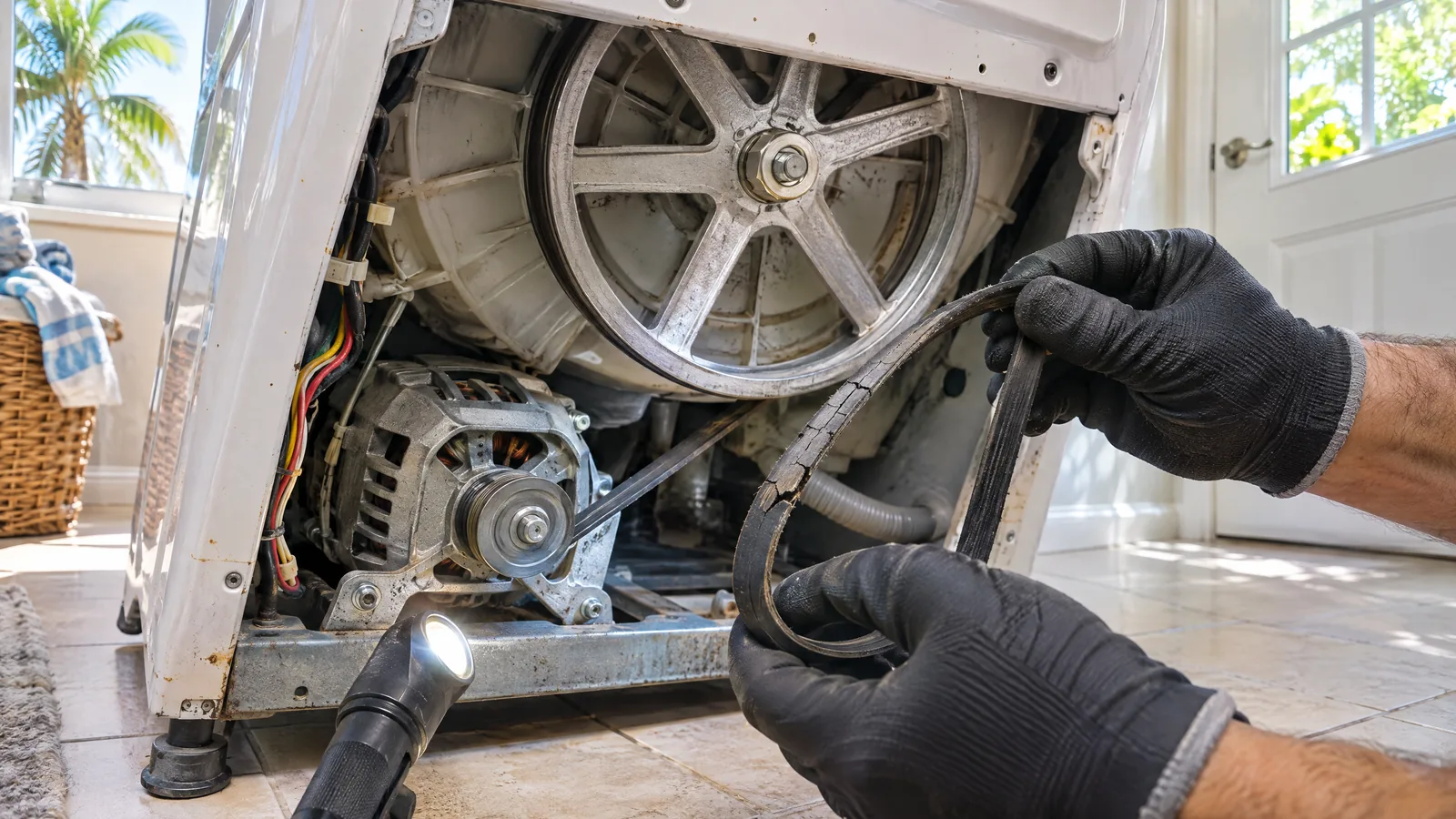
Broken or slipping drive belt
Many washers, top-load and front-load, turn the drum with a rubber belt from the motor pulley. How a technician confirms it: a burning-rubber smell during the last load, a squeal at the start of the spin, or a belt that’s visibly glazed, cracked or off its pulley once the access panel is open. HomeGuide puts belt replacement at $100 to $200, and Fixr at $120 to $175.
Motor coupling (direct-drive top-loaders)
Older direct-drive top-loaders connect the motor to the transmission with a small plastic-and-rubber coupling designed to break first if the washer is overloaded. How a technician confirms it: the motor runs, the basket neither spins nor agitates, and broken plastic bits sit under the washer. Fixr lists a coupling replacement at $85 to $160, one of the cheaper repairs on this list.
Clutch or shift actuator (top-loaders)
On many top-loaders the clutch or a shift actuator switches the drive between agitating and spinning. A worn clutch gives a slow spin that never reaches full speed; a failed shifter can leave the washer agitating but never spinning. HomeGuide puts a top-load clutch replacement at $200 to $300.
What if the washer is completely silent at the spin step?
No hum, no click, no movement usually means the washer has decided not to send power to the motor. Three parts are behind most of these:
- Lid switch or door lock. The washer has to know the lid or door is locked before it will spin. How a technician confirms it: no click of the lock engaging at the start of the spin, or a lock that clicks but the washer still reads it as open; a meter test on the switch settles it. HomeGuide lists $100 to $300 for a lid-lock and switch assembly, and Fixr lists $110 to $200 for a door lock.
- Motor or motor control. Samsung says a washer that never spins at all may need service for a motor issue. On Samsung models that support it, Calibration Mode is a useful test: with the drum empty, press and hold Temp. and Delay End for 3 seconds until “Cb” shows, then press Start/Pause. The tub should turn back and forth for 1 to 3 minutes. Samsung says if the tub doesn’t spin during calibration, request service.
- Main control board. The board runs the whole sequence, so a fault can stop the spin while everything else looks normal. HomeGuide puts a board replacement at $350 to $550, which is where the repair-or-replace question starts.
If your washer shows a code instead of just stopping, look the code up in the manual for your model before anything else; it often names the part. On a Whirlpool front-loader with a stuck door, our guide to opening a locked Whirlpool front-load door shows the safe way.
If the basket still won’t turn with the lid closed and the tub empty, the problem is a part, not a setting. That’s the point to book a technician rather than keep running cycles.
Does a Florida storm or power outage stop a washer from spinning?
It can. A washer that lost power in the middle of a cycle often sits with water in the tub, and the cycle won’t pick up where it left off. Once power is steady, run a Drain & Spin to finish the load before you start troubleshooting.
The bigger risk is the surge when power comes back. Ready.gov warns that power may return with momentary surges or spikes and advises disconnecting appliances and electronics during an outage. Modern washers rely on electronic control boards and motor controls, which are the parts a surge is most likely to damage. If your washer stopped spinning right after an outage or a lightning storm, and the free checks above don’t help, mention the outage when you book: it points the technician to the control electronics first.
Atlantic hurricane season runs from June 1 to November 30 (National Hurricane Center), Unplugging the washer when the lights go out costs nothing.
What does it cost to fix a washer that won’t spin?
HomeGuide puts the average washing machine repair at $100 to $400, with labor at $50 to $125 an hour and minimum service fees of $70 to $130. Fixr’s range is $150 to $400, with a national average of $300. Here’s how the spin-related parts compare across the two sources:
| Repair | HomeGuide | Fixr |
|---|---|---|
| Motor coupling | Not listed | $85 to $160 |
| Drive belt | $100 to $200 | $120 to $175 |
| Lid switch / door lock | $100 to $300 | $85 to $160 (lid switch), $110 to $200 (door lock) |
| Drain pump | $150 to $350 | $300 to $400 |
| Clutch (top-load) | $200 to $300 | Not listed |
| Transmission | $200 to $600 | $200 to $350 |
| Control board | $350 to $550 | Not listed |
Prices include parts and labor and vary with the brand, model and how hard the part is to reach. Appliance Doctor Pro’s technician explains the repair and its price before starting any work.
Prognosis: repair or replace?
- Repair when it’s a belt, coupling, lid switch, door lock or pump on a washer that’s otherwise sound. These sit at the low end of the table.
- Think hard when the quote is for a control board or transmission on a washer 7 years or older. HomeGuide says replacing is cheaper when a washer is 7 to 10 years old and needs frequent repairs.
- Usually replace when the tub bearings are gone (grinding, a wobbling basket and leaks together) on an older machine, or when the repair costs more than half the price of a comparable new washer (a common rule of thumb).
Worked example
An 8-year-old top-loader that agitates but won’t spin. A new comparable washer costs about $900 (HomeGuide’s range for a new washer is $700 to $1,300). If the cause is a $150 coupling or a $200 shifter repair, that’s well under half, and fixing it makes sense. If the diagnosis is a $500 control board, you’d be spending more than half the price of a new machine on an 8-year-old one, and replacing it is the better bet.
When to call a technician
Call once the free checks are done and the washer still won’t spin, or right away if you smell burning, hear grinding, or the motor hums while the basket stays still. Running it again and again with a broken belt or coupling can damage the motor. Appliance Doctor Pro repairs top-load and front-load washers from all major brands, including Whirlpool, Samsung and Maytag, with same-day appointments in most cases across Tampa Bay, Orlando, Jacksonville and Sarasota. If the washer is also loud or slow before it quits, our post on the signs of a failing washing machine motor is worth a read.
Frequently asked questions
Why is my washer not spinning all the water out?
Usually because the spin is slower than you think: a gentle or delicate cycle, a Low Spin setting the washer remembered from last time, too much detergent, or a load that’s out of balance so the washer won’t reach full speed. A partly clogged pump filter or drain hose does the same thing. Run Drain & Spin on High with the load spread out.
Can I reset a washer that won’t spin?
Unplugging it for a minute clears a stuck cycle on many models, and some brands have a test or calibration mode (Samsung’s is Temp. plus Delay End for 3 seconds on most models). A reset won’t fix a clogged drain, a broken belt or a failed lock, though. If it still won’t spin after a reset and the free checks, it’s a part.
Why does my washer spin on rinse but not on the final spin?
The final spin is the fastest one, so it’s the first to be cut when the load is unbalanced or there are too many suds. The washer may also slow down if it senses water hasn’t drained. Rebalance the load, check detergent, and clean the pump filter on a front-loader.
Appliance Doctor Pro
Washer still won’t spin?
Book a visit and a technician will diagnose it, explain the repair and the price before starting, and back the repair with a 90-day warranty. Same-day and next-day appointments are available, 7 days a week.
General information for common washer designs. Check your model’s manual for its exact cycles, codes and test modes, and unplug the washer before any check that goes beyond the controls.
Sources
- Whirlpool Product Help: Washer Not Draining or Spinning? Troubleshooting Guide
- Whirlpool Product Help: Not Spinning, Front Load Washer
- Samsung US Support: Samsung washing machine does not spin at all
- Samsung US Support: Samsung washing machine spins poorly
- HomeGuide: Washing Machine Repair Cost
- Fixr: Washing Machine Repair Cost
- Ready.gov: Power Outages
- National Hurricane Center: Tropical Cyclone Climatology