 Reviews
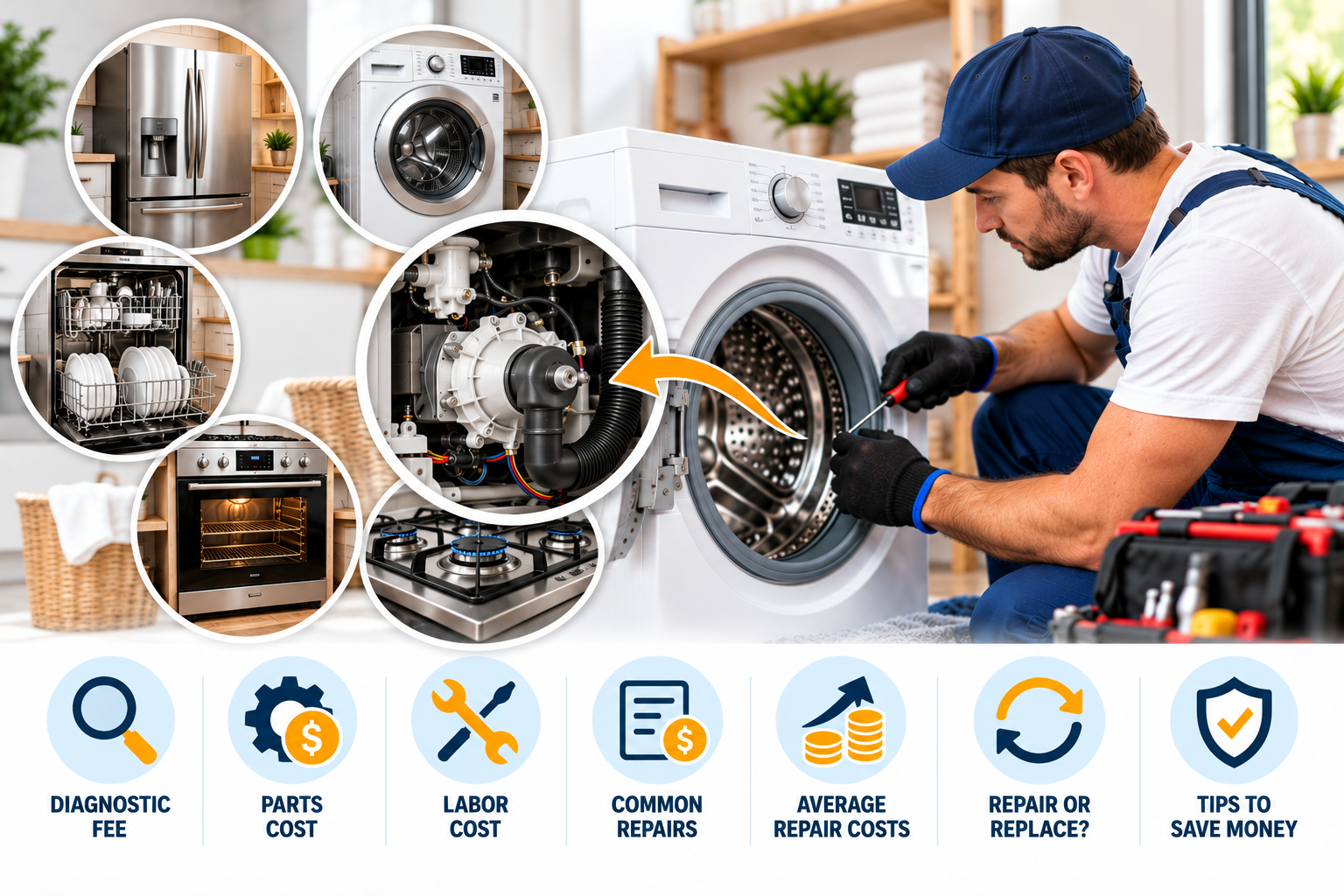
Expect to pay $100 to $400 for a typical appliance repair, parts and labor included, with a national average of about $200 (HomeGuide). This Old House reports a wider $50 to $500 spread. Where your bill lands depends on three things: the visit fee, the hours of labor and the part. Below: prices by appliance, what each line on the bill means, who pays when a warranty applies, and where repairing stops making sense.
Quick diagnosis
- Typical bill: $100 to $400 total; HomeGuide’s lowest reported job is $70 and its highest $700.
- Getting someone to the door: HomeGuide’s standard call-out fee of $70 to $130 normally buys the trip, the diagnosis and the first hour of work. An emergency call-out is $140 to $400.
- Cheapest repairs: switches, belts, valves and jams on washers, dryers, dishwashers and disposals.
- Most expensive: refrigerator compressors ($700 to $1,250) and control boards.
- Replace instead when the appliance is past 10 years old or the repair is more than half the price of a new one, per HomeGuide’s rule of thumb.
Triage
- Stop using it now: a gas smell (leave, then call the gas utility or 911 from outside), sparks, a burning smell, a tripping breaker or water near an outlet.
- Book a technician: anything inside a sealed refrigerant system, a gas valve or a control board, a fridge running warm with food inside, or an appliance that stays dead after the checks below.
- Safe to check yourself: the breaker and outlet, settings, filters and your warranty paperwork (covered below).
How much does appliance repair cost by appliance?
The refrigerator tops this list. The table sets each repair range next to how long that appliance usually lasts, because a $300 repair means something different on a 3-year-old dishwasher than on a 12-year-old one.
| Appliance | Typical repair (HomeGuide) | Average repair (This Old House) | Typical lifespan (InterNACHI) |
|---|---|---|---|
| Refrigerator | $125 to $500 | $400 | 9 to 13 years |
| Washing machine | $100 to $400 | $300 (washer or dryer) | 5 to 15 years |
| Dryer | $100 to $300 | $300 (washer or dryer) | 13 years |
| Dishwasher | $100 to $300 | $220 | 9 years |
| Oven | $150 to $350 | $300 | 10 to 18 years (gas oven) |
| Stove or cooktop | $100 to $300 | $250 (cooktop or range) | 13 to 15 years (electric range), 15 to 17 (gas range) |
| Freezer | $100 to $400 | Not listed | 10 to 20 years |
| Garbage disposal | $100 to $250 | $250 | 12 years |
Repair ranges include parts and labor and are national figures from HomeGuide and This Old House. Lifespans are InterNACHI figures as published by This Old House.
What decides the price of an appliance repair?
Every repair bill is built from the same few lines. Knowing them lets you spot the one driving a quote up.
| Line on the bill | Typical cost | What to ask |
|---|---|---|
| Standard service call | $70 to $130 (HomeGuide), usually travel, diagnosis and the first hour | Is the fee credited toward the repair if I go ahead? |
| Emergency or after-hours call | $140 to $400 (HomeGuide) | Can this safely wait for a regular slot? |
| Labor after the first hour | $50 to $125 an hour (HomeGuide) | Is this a flat price for the job or billed by the hour? |
| The part | From a few dollars (a belt) to hundreds (a board or compressor) | Is it on the truck, or does it need a second visit? |
| Home warranty service fee | Mostly $75 to $125 a visit (This Old House survey) | Does the plan cover this part, and is labor included? |
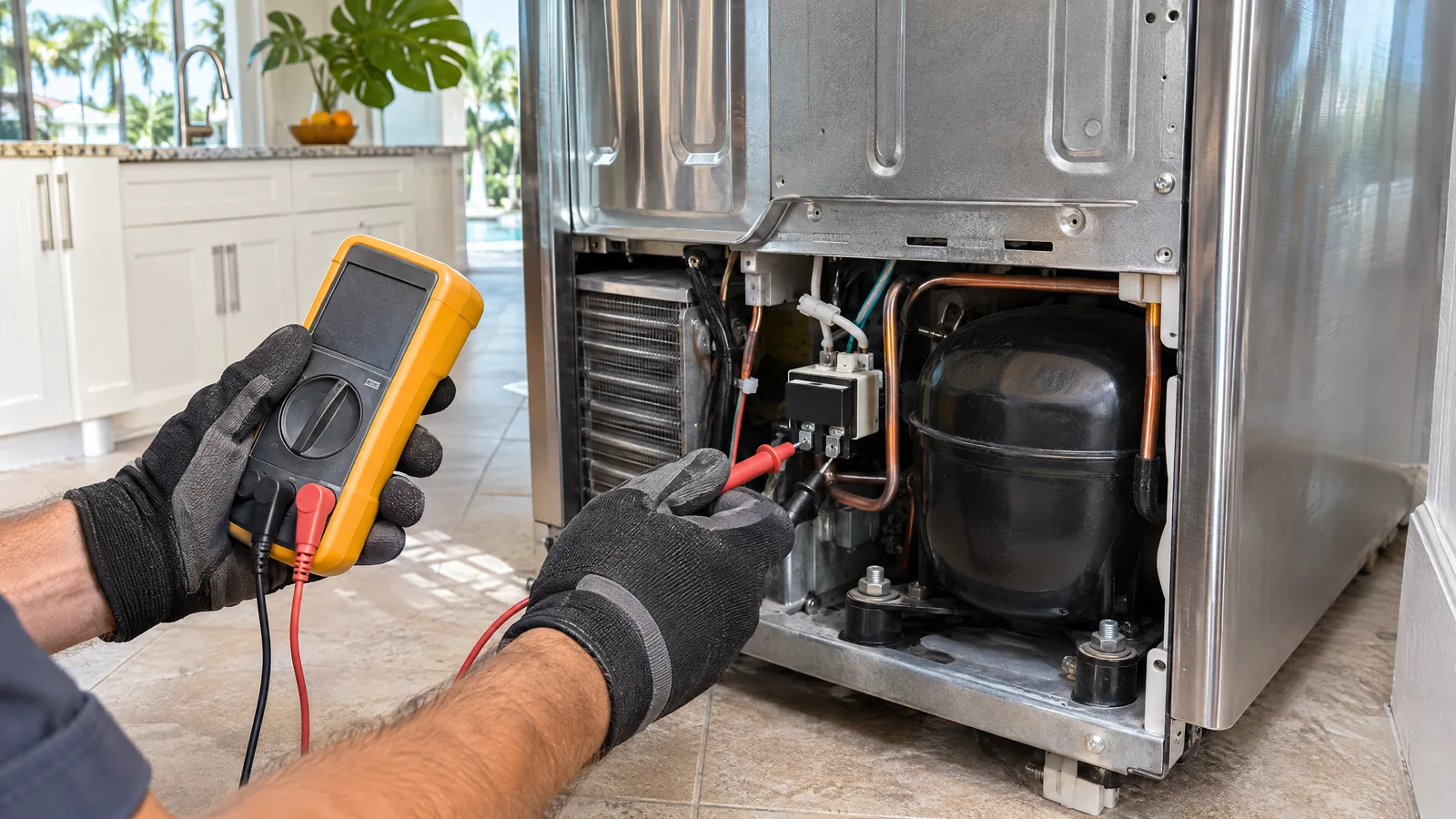
Five things move those lines up or down:
- Gas or electric. HomeGuide says gas appliances typically cost 10% to 20% more to repair: pricier parts, more safety risk, more experienced technicians.
- Access. Built-ins, stacked laundry and tight closets take longer to reach.
- Part availability. HomeGuide notes extra costs apply when a technician returns to fit a special-order part.
- Brand. High-end brands such as Sub-Zero use pricier parts, but a built-in also costs far more to replace, so repair often still wins.
- Timing. A dryer that won’t heat can wait for a regular slot. A warm refrigerator full of food usually can’t.
Which repairs are cheap and which are expensive, appliance by appliance?
The part that failed matters more than the appliance. Here’s where the cheap and expensive repairs sit, and how a technician tells them apart.
Refrigerators and freezers
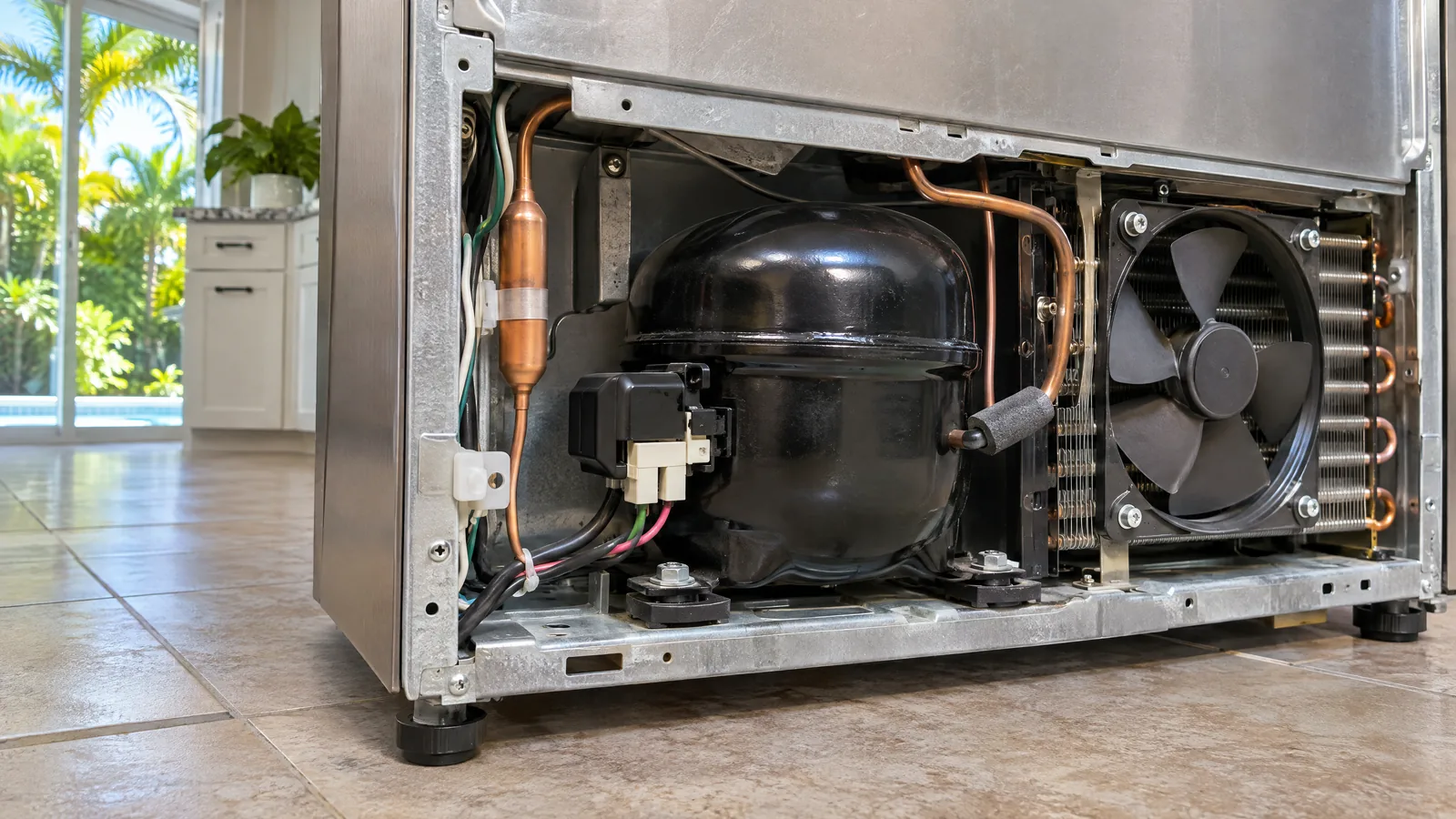
Refrigerators are the appliance people repair most: in a This Old House survey of 2,000 homeowners, nearly 54% named the refrigerator as the appliance they most recently had to repair or replace. Evaporator and condenser fan motors sit inside HomeGuide’s $125 to $500 range. A compressor is the expensive one at $700 to $1,250, because it’s sealed-system work that needs welding and a refrigerant recharge. How a technician confirms it: a cold freezer with a warm fresh-food section points to airflow (a fan or frost on the evaporator); both sections warm with the compressor silent or clicking on and off points to the start relay or the compressor itself, which a meter test separates.
Washing machines
Most washer repairs fall between $100 and $400 (HomeGuide): lid switches, belts, couplings and drain pumps at the low end, bearings, drums and control boards at the high end. Front-loaders generally cost more to fix than top-loaders. Our washing machine repair cost guide breaks the price down by part, by symptom and by brand.
Dryers
HomeGuide puts most dryer repairs at $100 to $300, with the heating element, thermal fuse, belt and start switch the parts replaced most often, and a drum or control board up to $500. How a technician confirms it: a drum that tumbles with cold air is a heat-circuit problem (fuse, element or gas igniter); a motor that hums with a still drum is a belt or idler. HomeGuide says most dryers last 6 to 10 years, while InterNACHI lists 13.
Dishwashers
Dishwasher repairs run $100 to $300 (HomeGuide), and This Old House’s average is $220. The pump, heating element and motor are the parts replaced most. A new dishwasher is $400 to $1,200 plus $200 to $500 to install, which belongs in the repair-or-replace math. Our post on dishwasher repair cost has more detail.
Ovens, ranges and cooktops
Oven repairs run $150 to $350 and stove repairs $100 to $300 (HomeGuide). Igniters and heating elements are the routine jobs, and HomeGuide names a glass stovetop or radiant surface elements as the most expensive cooktop repairs. Electric oven repairs usually cost less than gas. How a technician confirms it: on a gas oven, an igniter that glows but never opens the gas valve is weak, not dead, and a current reading proves it. Never work on a gas valve or line yourself.
Garbage disposals
Disposal repairs run $100 to $250, and a full replacement $200 to $550 (HomeGuide). A jam is the cheap fix. This Old House says a disposal that leaks or has a burnt-out motor is probably worth replacing, and HomeGuide suggests replacing one older than 12 years.
If the appliance still won’t run after the free checks below, the problem is a part. That’s the point to book a diagnosis rather than keep resetting it.
Before you pay for a visit: checks that cost nothing
Some “broken” appliances aren’t broken, and a few minutes of prep makes a real repair faster.
Before you touch anything
- Unplug the appliance or switch off its breaker before you open any panel or reach inside it. Turn off the water supply before touching a water line.
- Gas smell: don’t touch switches or try to light anything. Leave and call the gas utility or 911 from outside.
- Leave sealed refrigerant systems, gas valves and control boards to a technician, and never bypass a door lock or safety switch.
- Check power. Look for a tripped or half-tripped breaker (dryers and ranges use double breakers) and test the outlet with a lamp.
- Check settings. Control lock, delay start, a fridge dial turned down, a dryer left on air fluff.
- Clean the obvious filters. Dishwasher filter, dryer lint screen, a front-load washer’s pump filter. Samsung recommends cleaning its washer pump filter about once a month or every 40 washes.
- Photograph the rating plate. Model and serial numbers are on a label inside the door, on the frame or on the back. Sending them when you book lets the technician check part availability first.
- Write down the symptom and any code. “Freezer cold, fridge warm, clicks every few minutes” beats “it stopped working”.
- Find your purchase date and warranty. A repair under warranty is a different call (see below). Search the model number for open safety recalls too: a recalled appliance may be fixed by the manufacturer.
Will a warranty pay for the repair?
Sometimes, so check before you book. The main types work differently:
- Manufacturer’s warranty. Length and coverage vary by brand and model, so read the warranty card or manual. Some brands cover single parts longer: Fixr notes Samsung washers typically get one year on all parts and up to ten years on some components. HomeGuide notes many manufacturer warranties only cover the original buyer and don’t transfer to a new owner.
- Extended warranty. HomeGuide puts these at $100 to $300 for an extra 3 to 5 years and says they typically cover the part but not the labor, which is often the larger share of a repair bill.
- Home warranty. You pay a service fee for each visit; This Old House’s 2025 survey found those fees mostly run $75 to $125, with dissatisfaction rising sharply above $150.
- Renting? HomeGuide says the landlord typically has to repair appliances that came with the rental, depending on the lease, so tell your landlord before booking anything yourself.
Do Florida storms and surges change the repair math?
Yes, in two ways. First, surge damage tends to hit the expensive parts. The Atlantic hurricane season runs from June 1 to November 30 and peaks around September 10 (National Hurricane Center), and Ready.gov‘s outage advice is to turn off or disconnect appliances, because power can come back with momentary surges or spikes. Modern refrigerators, washers and dishwashers run on electronic control boards, among the priciest parts to replace. Pulling the plugs when the lights go out is the cheapest protection you have.
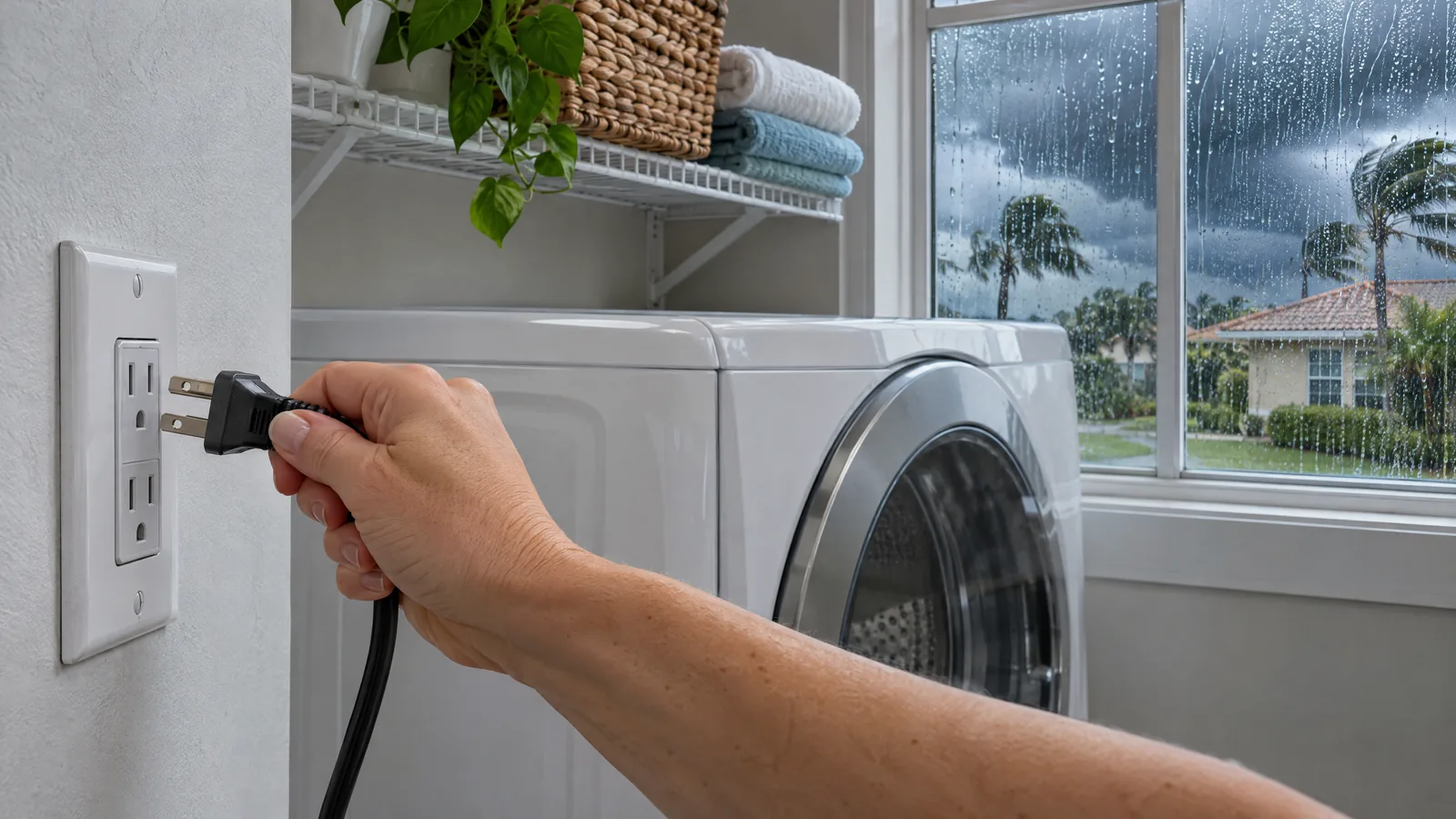
Second, if you’re an FPL customer, you may see a meter-mounted surge protector offered on your bill. FPL Home’s SurgeShield costs $11.95 a month plus tax and carries a $5,000 limited warranty per covered appliance, per occurrence, but only for damage caused by the protector failing to perform. Read the covered-appliance list before counting on it for a repair. Lifespans may also run differently here: InterNACHI notes its life-expectancy ranges may vary for homes in Florida and other coastal regions (This Old House), so treat the lifespan column above as a guide, not a deadline.
When is an appliance worth repairing?
HomeGuide draws the line at two points: an age past 10 years, or a repair bill above half the cost of a replacement. Past either one, it says a repair typically isn’t worth it. Put the quote next to the new price plus installation, and the age next to the lifespan column.
Prognosis: repair or replace?
- Repair when the appliance is in the first half of its typical life and the quote is a switch, belt, fan, igniter, pump or element.
- Think hard when the quote is a control board or drum on an appliance near the end of its typical life, or when it’s the second big repair in a year.
- Usually replace when the repair passes half the price of a comparable new unit, or when it’s a compressor on a refrigerator past 10 years old.
Worked example
An illustration from HomeGuide’s ranges, not a quote. An 8-year-old electric dryer tumbles but blows cold air on a Saturday evening. HomeGuide puts a new dryer at $800 to $1,200, so call it $1,000. If the diagnosis is a heating element or thermal fuse and the bill lands around $250, that’s 25% of a new dryer: repair it. If it’s the control board at up to $500, you’re at half the price of a new dryer on a machine already inside HomeGuide’s 6-to-10-year lifespan, and replacing is the stronger call. Timing matters too: a dryer that won’t heat isn’t an emergency, so a regular call ($70 to $130) instead of an after-hours one ($140 to $400) avoids a gap that can reach $270 before any part is priced.
When to call a technician
Call once the free checks are done and the appliance still won’t work, or right away for a burning smell, water near outlets or a refrigerator warming up with food inside. Appliance Doctor Pro repairs refrigerators, freezers, washers, dryers, dishwashers, ovens, cooktops and garbage disposals from all major brands, with same-day appointments in most cases across Tampa Bay, Orlando, Jacksonville and Sarasota. The technician diagnoses the problem, explains the repair and its price, and starts only once you approve. If you’re weighing a new appliance instead, our post on whether to repair or replace an appliance covers the decision.
Frequently asked questions
What is the average cost of appliance repair?
HomeGuide’s national average is about $200, with most repairs between $100 and $400 including parts and labor. This Old House’s averages by appliance run from $220 for a dishwasher to $400 for a refrigerator.
Does the diagnostic fee count toward the repair?
It depends on the company. HomeGuide says a standard $70 to $130 service call usually covers travel, diagnosis and the first hour of labor. Fixr notes many washer technicians waive the diagnosis fee when you go ahead with the repair. Ask when you book, not after the visit.
How much more does emergency appliance repair cost?
HomeGuide puts an emergency call-out at $140 to $400, against $70 to $130 for a standard call, before parts and extra labor. For washers, Fixr lists an emergency surcharge of $100 to $200. Save emergency calls for active leaks and refrigerators losing temperature with food inside.
Which appliance breaks down most often?
The refrigerator, by a wide margin. In This Old House’s survey of 2,000 homeowners, nearly 54% said the refrigerator was the appliance they most recently had to repair or replace. Ovens, ranges and cooktops were second at about 22%, and dishwashers third at about 7%.
Appliance Doctor Pro
Want a real number for your appliance?
Book a visit and a technician will diagnose the problem, explain the repair and the price before starting any work, and back the repair with a 90-day warranty. Same-day and next-day appointments, open 7 days a week.
General information based on national cost guides checked in November 2026. Prices vary by model, part and area; your technician gives the price for your appliance before any work starts.
Sources
- HomeGuide: How Much Does Appliance Repair Cost?
- This Old House: Appliance Repair Cost
- This Old House: Appliance Repair Statistics (InterNACHI lifespans, homeowner survey)
- Fixr: Washing Machine Repair Cost
- Samsung US Support: Washing machine spins poorly (pump filter cleaning)
- Ready.gov: Power Outages
- National Hurricane Center: Tropical Cyclone Climatology
- FPL Home: Surge Protection (SurgeShield)