 Reviews
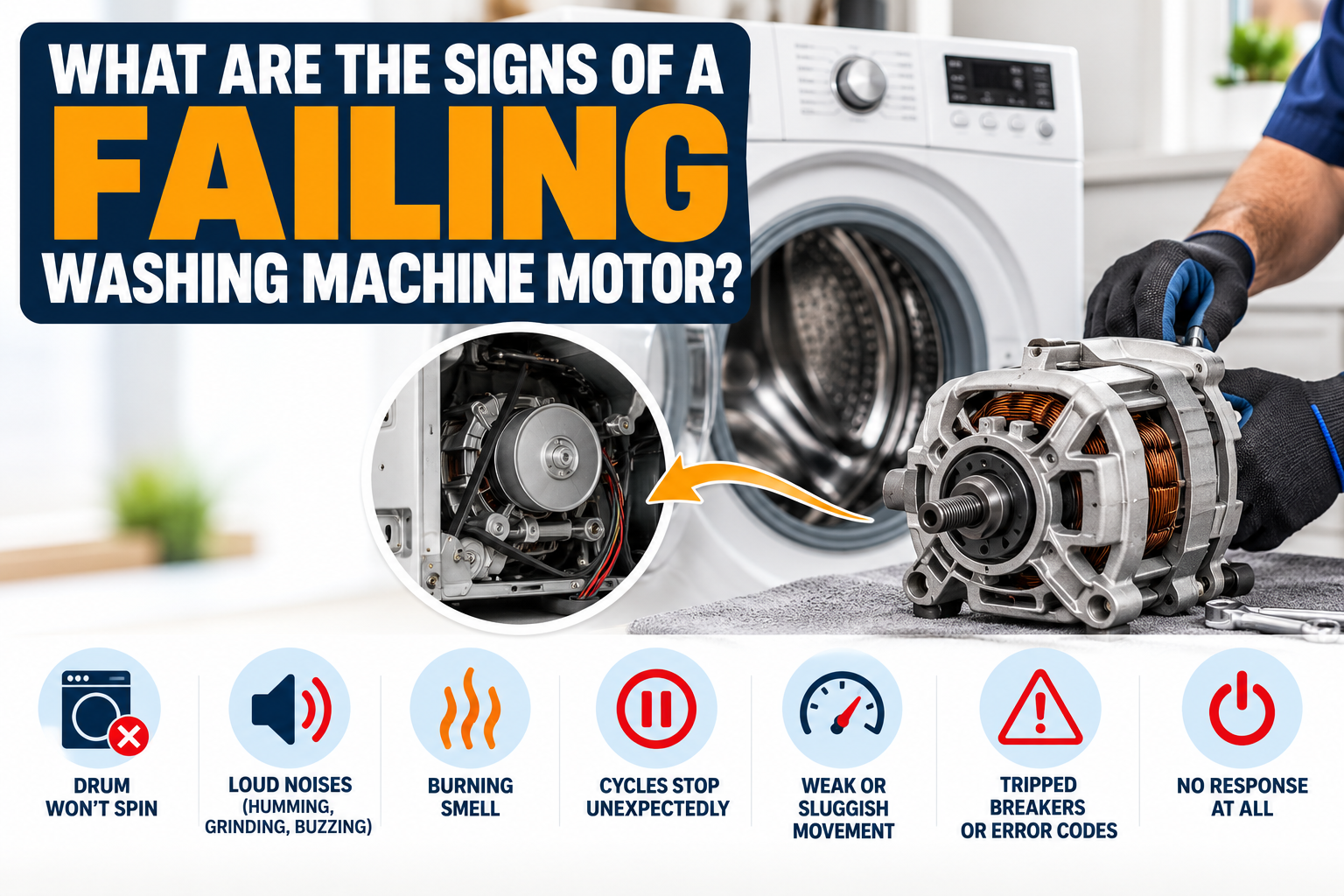
The signs of a failing washing machine motor are a hum with no drum movement, a weak spin, a hot electrical smell, cycles that stop and restart after a rest, a tripped breaker, and motor or speed error codes. But a broken coupling, a weak capacitor, worn brushes, a bad position sensor or a failed motor control board cause the same symptoms for less money. Here’s how to tell them apart and when a new motor is worth buying.
Quick diagnosis
- Hums but the drum won’t move: on an older top-loader, think coupling or start capacitor before the motor. On a direct-drive front-loader, think position sensor or motor control first.
- Spins weakly: check overload, suds and the belt before the motor; worn carbon brushes on washers that use them.
- Stops mid-cycle, runs again after it cools: the motor’s thermal protector is tripping. That’s a real motor warning.
- Hot electrical smell, smoke or a tripping breaker: stop using the washer and unplug it.
- A new motor runs $300 to $700 installed per HomeGuide, so rule out the cheaper look-alikes first.
Triage
- Stop using it now: a burning smell, smoke, sparks, a breaker or GFCI that trips when the washer starts, or a motor that hums for more than a few seconds without turning. Unplug it.
- Book a technician: a motor or motor-speed error code that returns after a reset, a drum that stays still while the motor runs, or a washer that shuts off mid-cycle again and again.
- Safe to check yourself: which noises are normal, the load size, shipping bolts on a new front-loader, a power reset and the error code in your manual.
Symptom checker: signs of a failing washing machine motor, or a look-alike?
Several cheaper parts sit between the motor and the drum, or tell the motor what to do, and they fail in ways that look like a dead motor. Match what you see to the likeliest cause.
| What you notice | Most likely cause | Who fixes it |
|---|---|---|
| Motor runs, drum doesn’t turn, plastic bits under an older top-loader | Broken motor coupling | Technician |
| Loud hum at the start, no rotation, older top-loader | Weak start capacitor or a seized motor | Technician (capacitors hold a charge) |
| Drum twitches or jerks, then a motor or speed code | Position (Hall) sensor, loose motor wiring or motor control board | Technician |
| Weak spin that gets worse over months, washer that uses brushes | Worn carbon brushes | Technician |
| Shuts off mid-cycle, restarts after cooling | Motor overheating and tripping its thermal protector | You first (load size); technician if it repeats |
| Breaker or GFCI trips when the motor starts | Shorted motor winding or wiring | Technician |
| Grinding or roaring that rises with spin speed | Tub bearings, sometimes motor bearings | Technician (often a repair-or-replace call) |
Which kind of motor does your washer have?
The look-alike parts depend on your washer’s drive design, shown in the parts list for your model.
- Older direct-drive top-loaders: a motor under the tub, joined to the transmission by a small plastic-and-rubber coupling, usually with a start capacitor.
- Belt-drive washers: the motor turns the drum through a belt. A slipping belt looks exactly like a motor losing power.
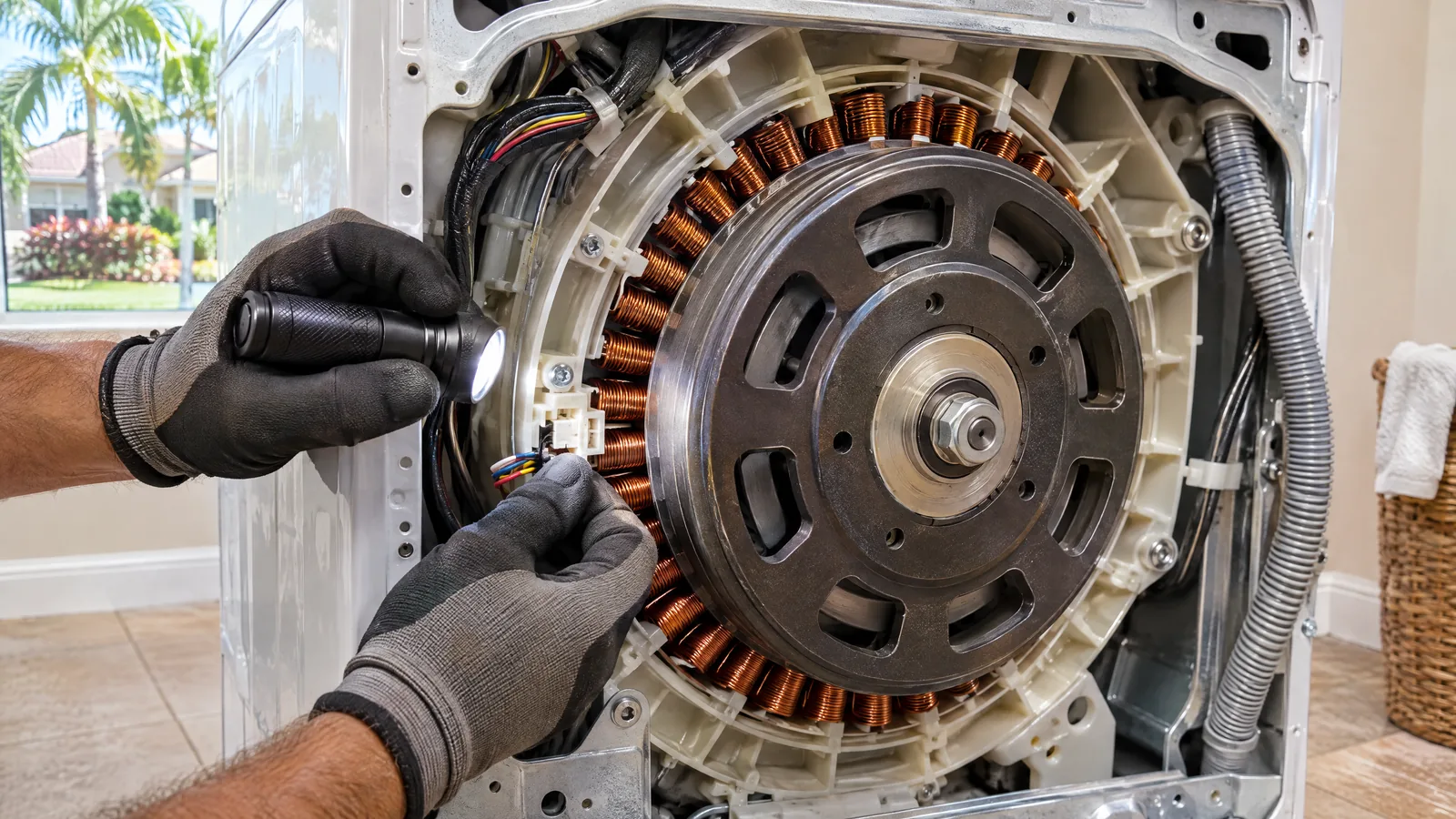
- Inverter direct-drive washers (many newer front-loaders and some top-loaders): a flat stator and magnet rotor on the back of the tub, run by a motor control board and a position sensor. Few wearing parts, so failures are usually electronic.
- Brush motors: HomeGuide notes that carbon brushes are common on washers made outside the United States, and worn brushes stop the machine from spinning.
Check these first (no tools needed)
Several noises that sound like a dying motor are normal, and some “motor” codes clear without a part.
Before you touch anything
- Unplug the washer before you reach into the drum, pull it away from the wall or touch anything behind it.
- Never run the washer with a panel off, and never test a motor, capacitor or control board while it’s plugged in. A motor capacitor can stay charged after the power is off.
- Smelled burning or saw smoke? Skip these checks and book a technician.
- Listen for normal sounds. Whirlpool says humming or whirling during the wash and spin is the motor turning the basket, and the drain pump hums too near the end of draining. Samsung says a click followed by a short thump is the clutch changing between washing and spinning, which needs no service.
- Take some laundry out. Whirlpool says an overloaded top-loader grinds louder than normal, and Samsung says squealing or grinding is due to overloading in most cases. Samsung’s test: run about four soaking-wet bath towels. Noise with that small load means service; no noise means the load was the problem.
- On a new front-loader, check the shipping bolts. Whirlpool lists F7 E1 as a motor speed sensing error (the motor can’t reach the right speed), and its first check is that all four shipping bolts and their plastic spacers were removed from the back.
- Do a 5-minute power reset. Whirlpool’s instructions for that code are to unplug the washer for 5 minutes, then plug it back in. A one-time code that never returns isn’t a motor failure.
- Let a hot motor cool. If it quit mid-cycle with a heavy load, leave it unplugged until it cools, then run a small load. Tripping on small loads too means a technician.
- Write down any code and look it up in your model’s manual, which says whether a reset is allowed.
If the motor still hums without turning the drum, trips the breaker or keeps throwing the same code, the problem is a part. Book a technician rather than running test cycles that can burn out a stalled motor.
What can mimic a bad washing machine motor?
A technician rules these out before condemning the motor, starting with whichever ones your washer’s design uses.
Motor coupling (older direct-drive top-loaders)
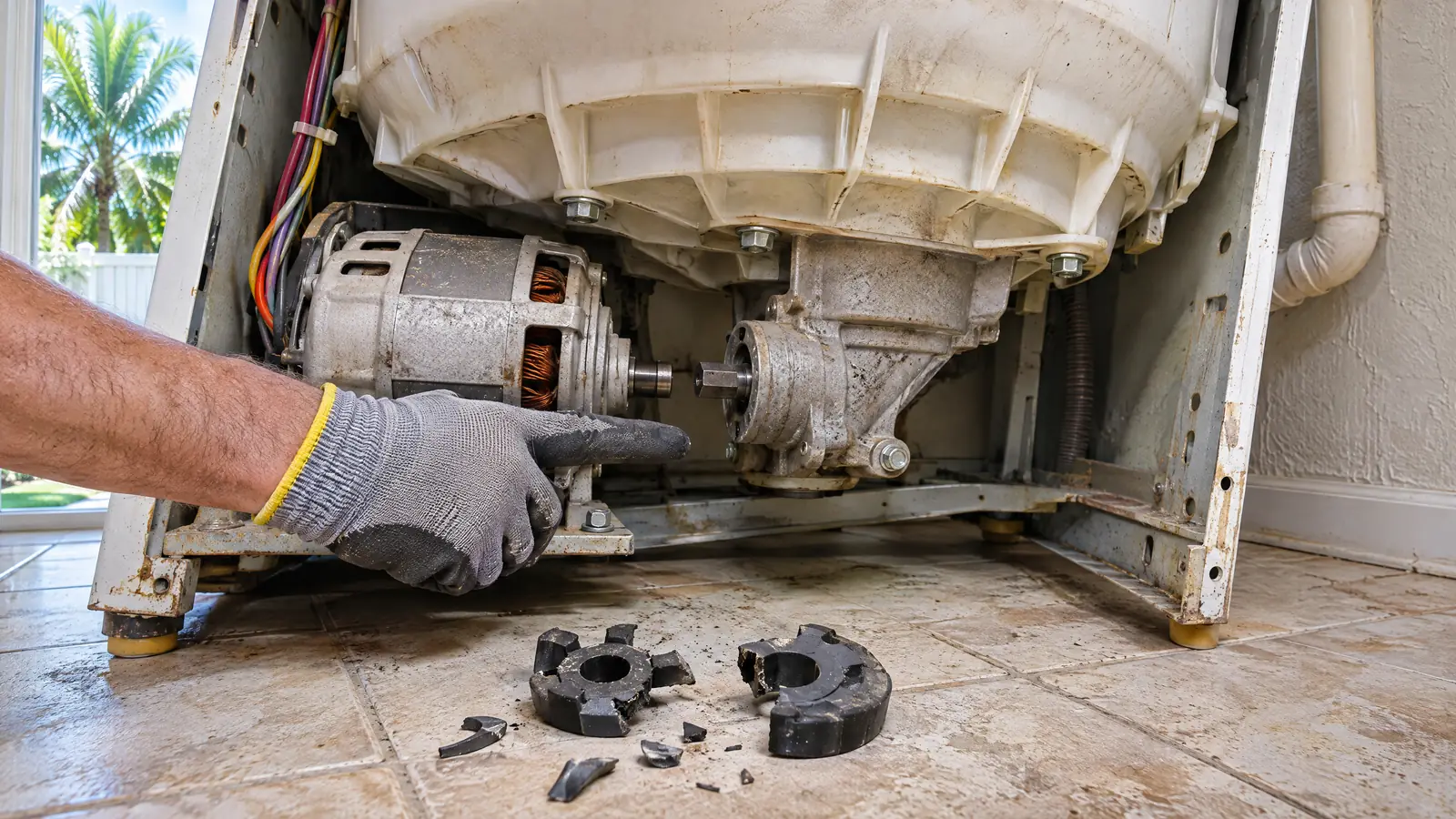
The coupling joins the motor to the transmission and is built to break before the motor or transmission does when the washer is overloaded. How a technician confirms it: the motor spins freely and quietly, the basket neither agitates nor spins, and broken plastic or rubber pieces sit under the washer once the cabinet is opened. Fixr lists coupling replacement at $85 to $160, and HomeGuide at $100 to $250.
Start or run capacitor
Many older top-load motors use a capacitor to get started. When it weakens, the motor hums and stalls instead of turning. How a technician confirms it: the capacitor is discharged and metered against its rated value with the power off; a bulged or leaking case is a giveaway. Not a homeowner job: a capacitor can hold a charge after the washer is unplugged.
Carbon brushes
On brush-type motors, two carbon blocks press against the spinning part of the motor and wear shorter with every load. How a technician confirms it: worn-down or chipped brushes, sparking marks, and a spin that has been getting weaker for weeks. HomeGuide puts brush replacement at $100 to $200 and says it takes 15 to 30 minutes.
Rotor position (Hall) sensor and motor wiring (direct-drive washers)
An inverter direct-drive motor uses a small sensor on the stator to tell the control board where the rotor is. When the sensor or its plug fails, the drum jerks or won’t start and the washer shows a motor or speed code, even though the windings are fine. How a technician confirms it: tests the sensor and wiring with the washer off, looks for a loose or corroded plug at the stator, and inspects the rotor magnets and stator behind the rear panel.
Motor control board (inverter)
On newer washers a separate board, or part of the main board, turns household power into the variable power the motor needs. When it fails, the washer sits silent or flashes a motor code. How a technician confirms it: if the windings and sensor test good with the power off, the board feeding them is the problem. HomeGuide lists control board replacement at $350 to $550, and Fixr lists a washer motherboard at $250 to $400.
Drive belt (belt-drive washers)
A glazed or stretched belt slips under load: the drum turns slowly while the motor sounds normal, often with a squeal or a hot-rubber smell. Our guide to a washer not spinning covers belts, drain problems and lid locks in full.
When it really is the motor
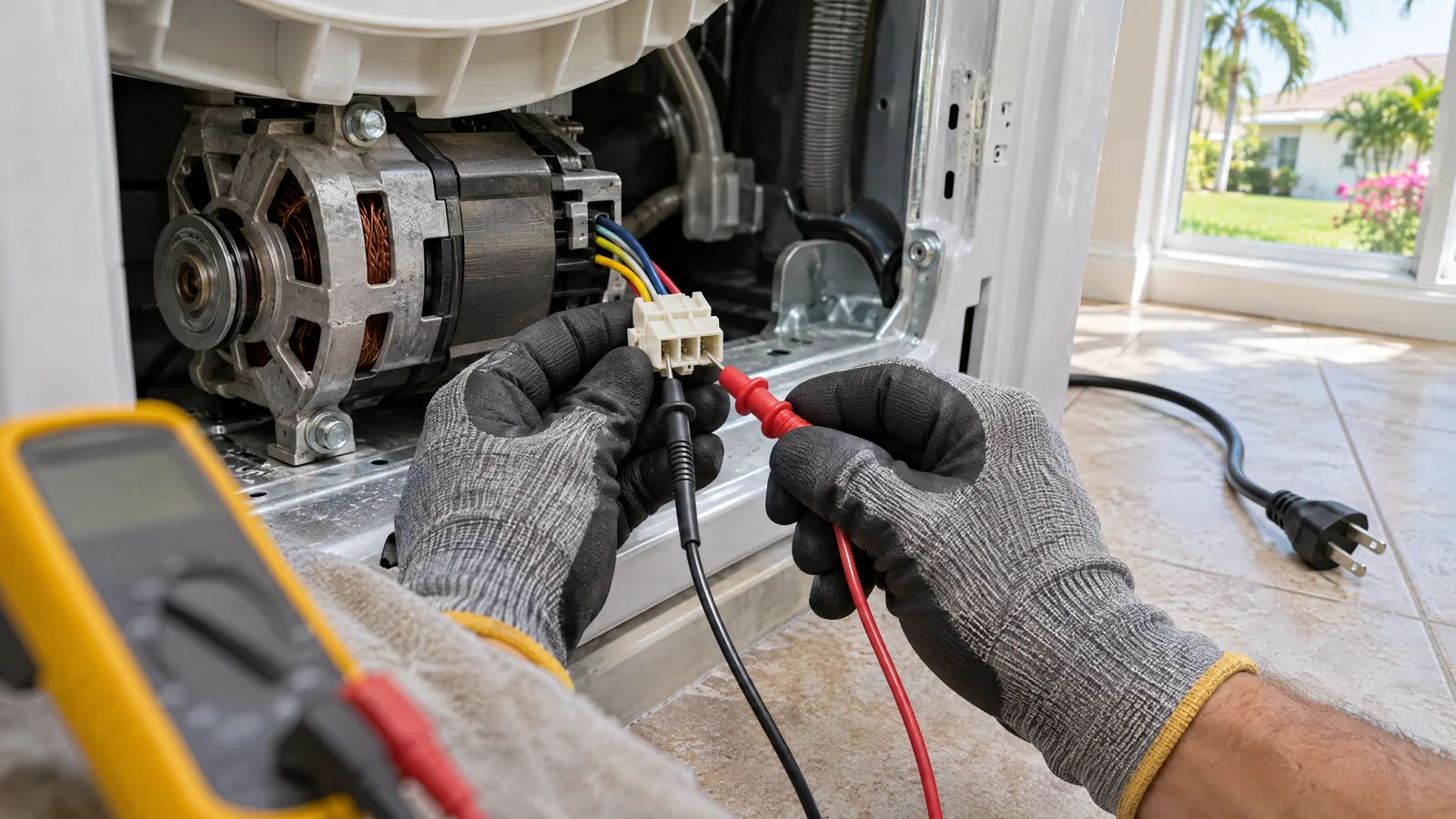
A motor itself fails in three ways: a winding opens or shorts (no movement, or a tripped breaker), the bearings wear (a growl or roar from the motor, not the tub), or it overheats repeatedly until the thermal protector trips on normal loads. How a technician confirms it: with the washer unplugged and the motor disconnected, the windings are checked with a meter for continuity and for a short to the metal frame. An open winding or a path to ground condemns the motor.
How does a technician test a washing machine motor?
Almost entirely with the power off, in this order:
- Turn the drum by hand. A tight or gritty drum points to tub bearings or a jam, not the motor.
- Check what connects motor and drum: coupling, belt, pulley or rotor bolt.
- Meter the windings: continuity across each one, none to the frame.
- Test the helpers: capacitor, brushes or position sensor.
- Only then suspect the board that drives a motor and sensor that tested good.
Can a Florida power surge damage a washer motor?
Yes, mostly through the electronics that run it: the control board and position sensor of an inverter motor. Ready.gov warns that power may return with momentary surges and advises disconnecting appliances and electronics to avoid surge damage.
Atlantic hurricane season runs from June 1 to November 30, per the National Hurricane Center. If motor codes started right after an outage or a lightning storm, say so when you book: it puts the board and sensor ahead of the motor on the list. Unplugging the washer when the lights go out costs nothing.
What does washing machine motor replacement cost?
A new motor is one of the bigger washer repairs. Prices include parts and labor and vary by brand and model.
| Repair | HomeGuide | Fixr |
|---|---|---|
| Motor coupling | $100 to $250 | $85 to $160 |
| Carbon brushes | $100 to $200 | Not listed |
| Drive belt | $100 to $200 | $120 to $175 |
| Control board | $350 to $550 | $250 to $400 |
| Motor | $300 to $700 | $300 to $500 |
Appliance Doctor Pro’s technician explains the repair and its price before starting any work.
Check the motor warranty before you pay
Some manufacturers cover the motor far longer than the rest of the washer. Samsung’s US warranty page, for example, lists 10 years of coverage on the Digital Inverter Motor for washers bought on or after April 1, 2026, with a purchase receipt, while other parts follow the standard 1-year warranty. Other brands print their terms on the warranty sheet that came with the washer; check whether motor coverage includes labor or the part only.
Prognosis: repair or replace?
- Repair when the cause is a coupling, capacitor, brushes, belt or position sensor, or when a failed motor is under warranty or the washer is young and otherwise sound.
- Think hard about a new motor or control board on a washer that’s 7 years or older. HomeGuide says replacing is cheaper when a washer is 7 to 10 years old and needs frequent repairs.
- Usually replace when the motor and tub bearings are both worn, or the repair costs more than half the price of a comparable new washer, the rule of thumb Fixr also uses.
Worked example
A 9-year-old top-loader hums and won’t agitate or spin. A comparable new washer costs about $1,000 (HomeGuide’s range for a new washer is $700 to $1,300). A broken coupling, at roughly $85 to $250 across the two sources, is well under half: fix it. If the windings test open, a $300 to $700 motor can pass the $500 halfway mark on a 9-year-old machine, and a new washer is usually the better buy.
When to call a technician
Call if the motor still hums without moving the drum, the same motor code comes back, the washer shuts off mid-cycle on normal loads, or any time you smell burning or a breaker trips. Running a stalled motor again and again can turn a cheap coupling or capacitor job into a motor replacement. Appliance Doctor Pro repairs top-load and front-load washers, including Samsung, LG and Whirlpool direct-drive and belt-drive models, with same-day appointments in most cases across Tampa Bay, Orlando, Jacksonville and Sarasota.
Frequently asked questions
How do you know if a washing machine motor is broken?
A broken motor hums without turning the drum after the coupling, belt and capacitor check out, trips the breaker as it starts, or stays silent while the controls work. A technician confirms it by testing the windings with the washer unplugged; symptoms alone can’t separate a motor from its control board.
How do I tell if the washer motor coupler is bad?
On an older direct-drive top-loader, the motor runs but the basket neither agitates nor spins, and you may find broken plastic or rubber bits under the washer. The coupling is designed to break when the washer is overloaded, so it often fails after a heavy comforter or rug load. It’s one of the cheaper washer repairs, at roughly $85 to $250.
Why does my washing machine motor hum but not turn?
The motor is getting power but can’t start turning. On older top-loaders the usual causes are a weak start capacitor, a jammed transmission or a seized motor. On direct-drive washers it’s often the position sensor, its plug or the motor control board. Unplug the washer right away: a stalled motor heats up fast.
Can a washing machine motor be repaired instead of replaced?
Sometimes. Brushes, capacitors, couplings, position sensors and loose motor plugs are replaced on their own and revive many motors that seemed dead. A motor with an open or shorted winding or worn bearings is normally replaced as a unit.
Can I replace a washer motor myself?
It’s possible on some models, but it involves capacitors that can hold a charge, heavy parts and, on direct-drive washers, rotor bolts and magnets behind the tub. Get a diagnosis first, because the motor is often not the failed part, and never test a motor or board with the washer plugged in.
Appliance Doctor Pro
Washer motor acting up?
Book a visit and a technician will find out whether it’s the motor or a cheaper part, explain the repair and the price before starting, and back the repair with a 90-day repair warranty. Same-day and next-day appointments are available, 7 days a week.
General information for common washer designs. Check your model’s manual for its codes, reset steps and warranty.
Sources
- Whirlpool Product Help: Humming or Whirling Noise, Top Load Washer
- Whirlpool Product Help: Grinding or Rubbing Noise
- Whirlpool Product Help: F7 E1, Front Load Washer
- Samsung US Support: Samsung washing machine is too noisy
- Samsung US: Know your warranty, washers and dryers
- HomeGuide: Washing Machine Repair Cost
- Fixr: Washing Machine Repair Cost
- Ready.gov: Power Outages
- National Hurricane Center: Tropical Cyclone Climatology