 Reviews
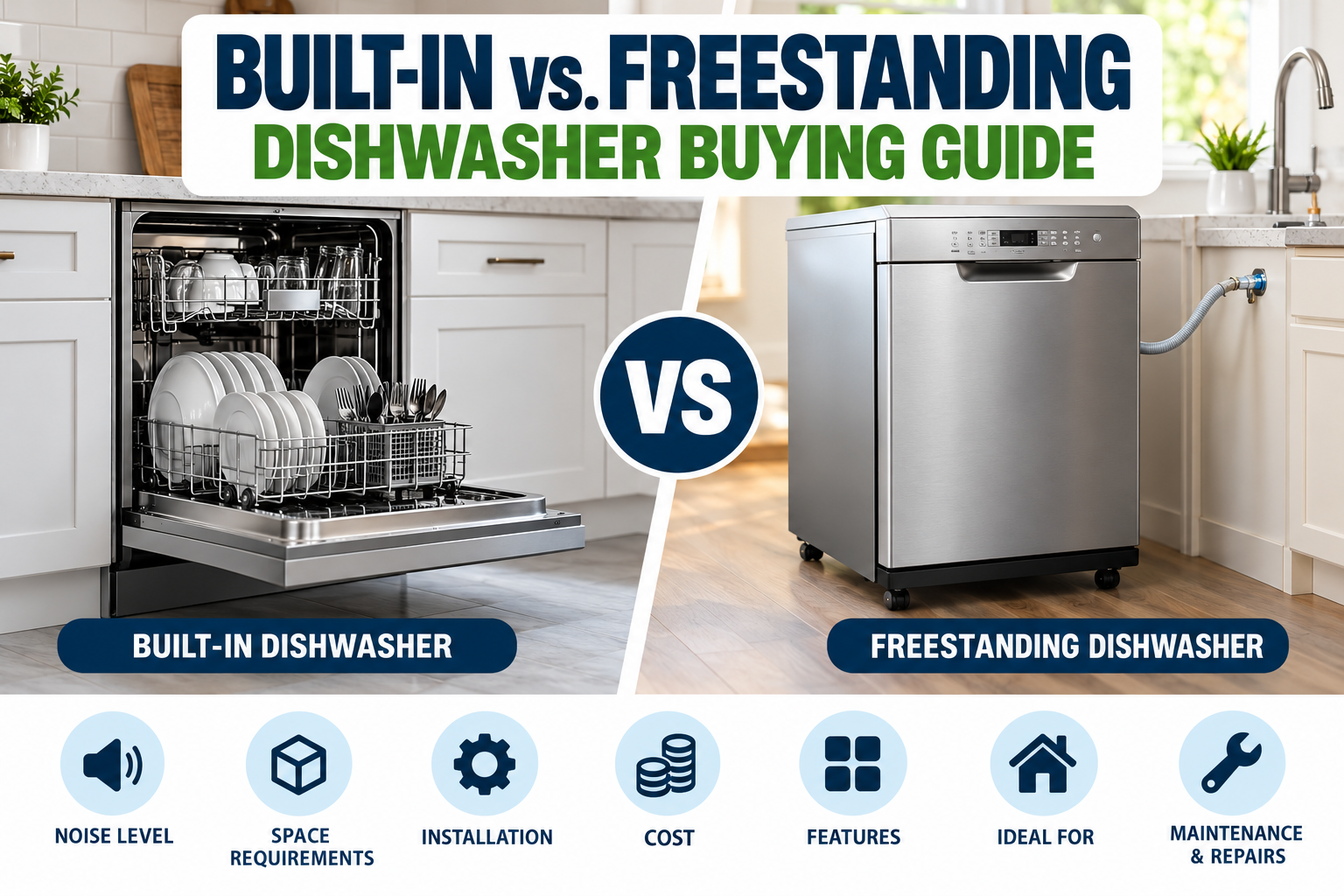
A built-in dishwasher sits permanently under the counter in a 24-inch (or 18-inch) opening, connected to a hot-water line, the sink drain and household power. A freestanding dishwasher, a portable on casters or a countertop unit, borrows water from the kitchen faucet and drains into the sink. Built-ins are usually quieter and hold more; freestanding units suit renters and kitchens with no opening. Below: real dimensions, noise ratings, installation costs, energy rules and repair differences.
Quick diagnosis
- You own the home and have a 24-inch opening with plumbing: a built-in is the better long-term machine, and a straight swap is the cheapest install.
- You rent, or there’s no cabinet space: a portable on casters (full capacity, connects to the faucet) or a countertop unit (compact) avoids plumbing and cabinet work.
- Noise matters: compare dBA ratings. In the manufacturer specs below, a built-in rated 44 dBA and a portable rated 54 dBA are 10 dB apart, which the NIDCD says sounds about twice as loud.
- Adding a dishwasher where none existed costs $300 to $1,300 in labor alone, per HomeGuide, before the unit.
Triage
- Stop using it now: water on the floor under a built-in, a portable’s faucet connector spraying, a burning smell or a tripping breaker. Cut the power and close the water supply.
- Book a technician: installing a built-in where there wasn’t one, replacing a built-in with old supply or drain connections, or any dishwasher that leaks, won’t drain or won’t start.
- Safe to check yourself: the opening size, the outlet and shutoff valve under the sink, and whether your faucet takes a threaded adapter.
Built-in vs freestanding dishwasher: the differences at a glance
Both types wash the same way inside; they differ in how they connect, how much they hold, how loud they are and what installation costs. The noise, size and weight figures below are from two current manufacturer spec pages, a Bosch 500 Series built-in and a GE 24-inch portable, as examples rather than averages.
| Factor | Built-in | Freestanding (portable or countertop) |
|---|---|---|
| Water and drain | Hot-water supply line and drain hose to the sink drain or disposal | Faucet adapter; drains into the sink |
| Example size | Bosch: 34 1/16 in high, 23 9/16 in wide, 22 9/16 in deep; needs a 24-inch-wide cutout | GE portable: 36 in high, 23.625 in wide, 25.375 in deep |
| Example capacity | Bosch: 15 place settings | GE portable: 12 place settings; countertop units are compact |
| Example noise | Bosch: 44 dBA | GE portable: 54 dBA |
| Installation | $200 to $500 labor for a swap; $300 to $1,300 where there was none (HomeGuide) | No installation, possibly a delivery fee (Fixr) |
| Moves with you | No | Yes, but the GE portable weighs 147 lb |
Will a built-in dishwasher fit your kitchen?
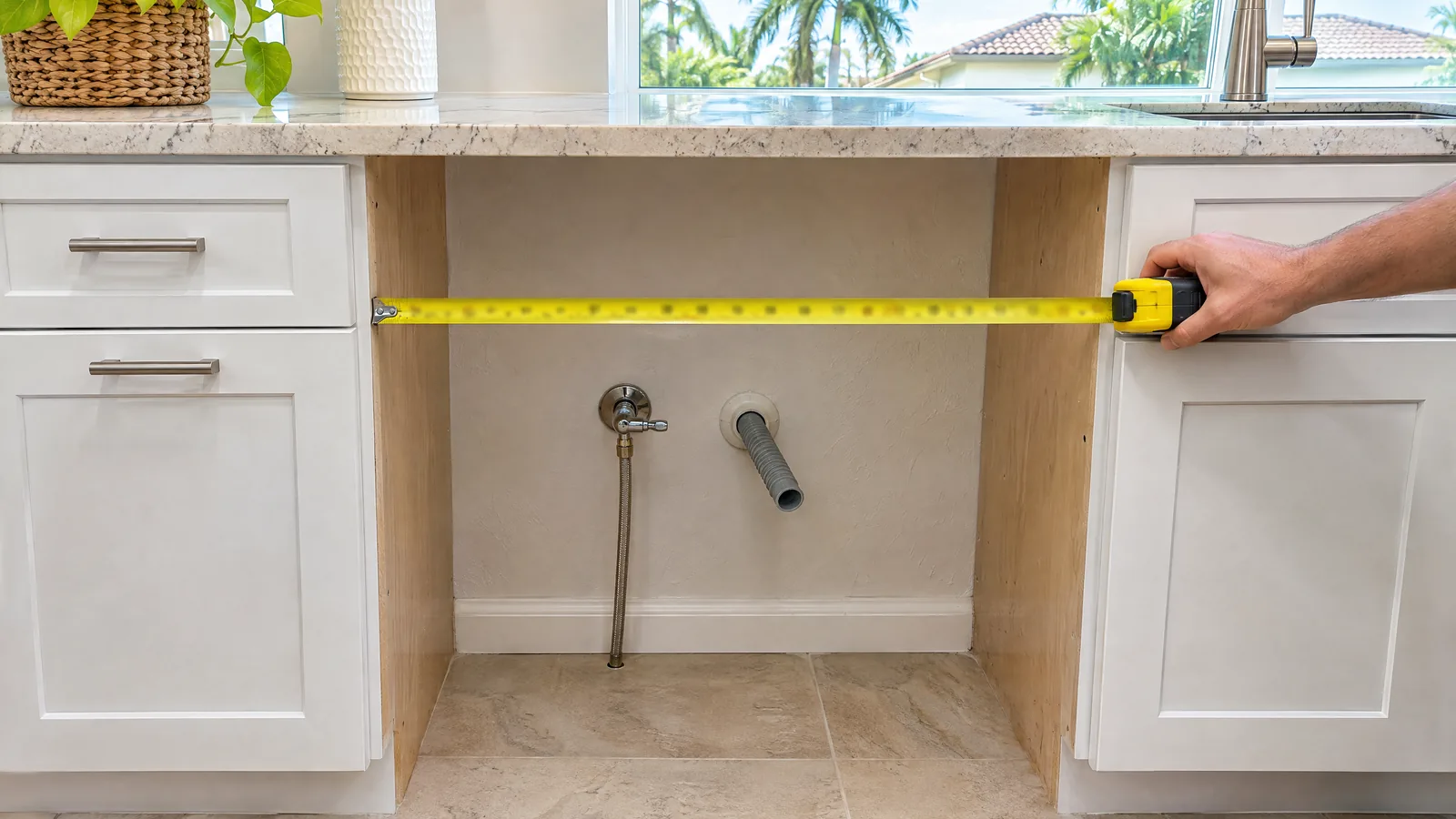
Built-ins are described by the opening they need, not the width of the machine. The Bosch above is 23 9/16 inches wide but needs a cutout 34 1/8 inches high, 24 inches wide and 24 inches deep. For tight kitchens there are 18-inch models: Bosch’s 18-inch SPE53C55UC needs a cutout 32 1/8 inches high, 17 3/4 inches wide and 21 2/3 inches deep, holds 10 place settings and is rated 46 dBA. Always measure the opening and compare it with the “required cutout” line in the spec sheet of the exact model, not the “overall dimensions” line.
Before you touch anything
- Measuring an empty opening is safe. If an old built-in is still in place, turn off its breaker and close the hot-water shutoff under the sink before you remove the kick plate or pull it out.
- Don’t disconnect the water line or electrical connection of an old built-in unless you’re sure the power is off. If it’s hardwired, that work belongs to a technician or an electrician.
- Width: measure the opening at the top, middle and floor. Use the smallest number.
- Height: measure from the floor to the underside of the countertop at the front and the back. New flooring can steal height from an old opening.
- Depth: measure from the back wall to the front of the cabinets, and note any pipes or outlets on the back wall.
- Door swing: open space in front for the door to drop fully, clear of an island, a corner cabinet or the oven handle.
- Connections: look in the sink cabinet for a hot-water shutoff valve with a free outlet, a drain or disposal inlet for the dishwasher hose, and an outlet or a junction box.
- For a portable: check that your faucet has a threaded tip. GE says its faucet adapter fits standard spouts with internal or external threads.
What does each type need to install?
Built-in: water, drain, power and a secure fit
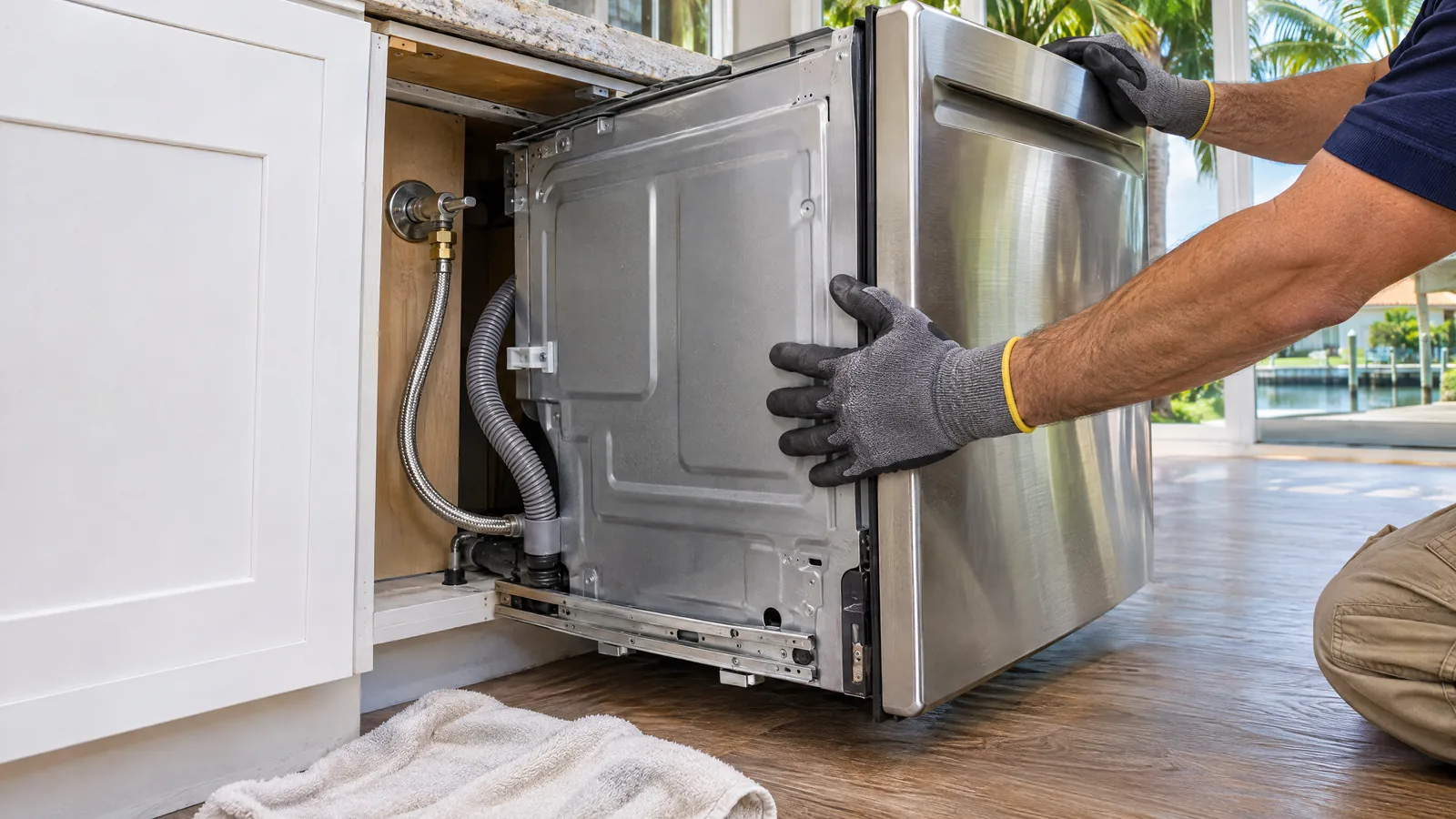
A built-in needs a hot-water supply line, a drain hose run to the sink drain or garbage disposal, and power from an outlet or a hardwired connection. It’s leveled on adjustable feet and fastened to the countertop or the cabinets beside it so the door doesn’t tip it forward. HomeGuide lists these costs:
- Replacing a built-in in the same spot: $200 to $500 for labor, usually 1 to 2 hours.
- Installing where there wasn’t one: $300 to $1,300 for labor, up to 6 hours with no existing connections; removing a cabinet adds $150 to $400.
- Running a water-supply line: $150 to $250. Rough-in plumbing for a new location: $400 to $600 minimum.
- A new outlet: $150 to $350. A new electrical circuit: $250 to $900. Permits, where required: $25 to $100.
- An air gap: $80 to $150. A high drain loop or a built-in backflow device are alternatives that keep dirty sink water out of the dishwasher.
Fixr puts a typical installation at $400 to $1,500 including the appliance, with an average of $1,000, and says relocating a dishwasher to a new spot in the kitchen averages $2,600. Our step-by-step on how to replace a dishwasher shows what a swap involves.
Portable: the faucet does the plumbing
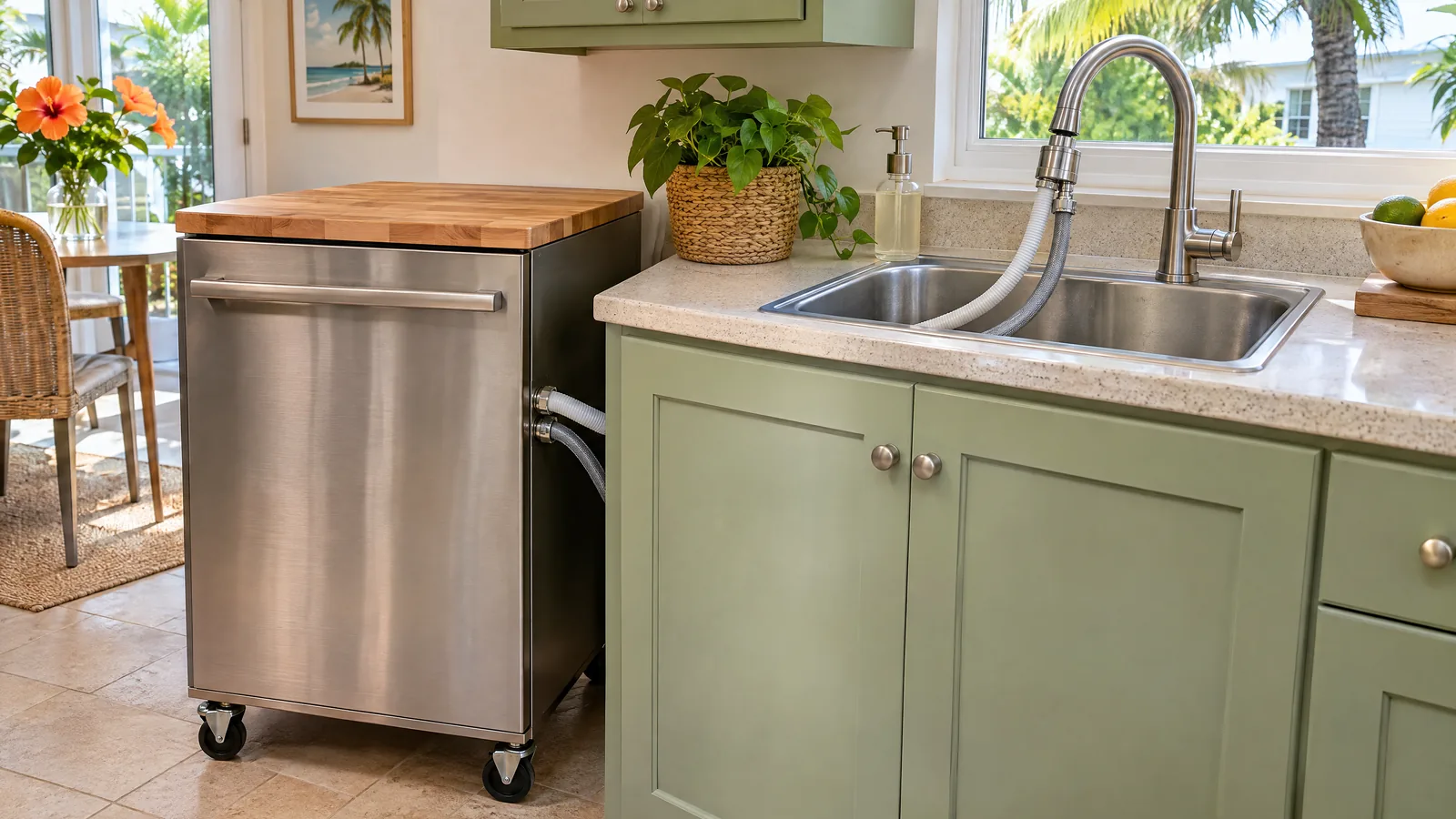
GE says a portable dishwasher must be connected to a kitchen sink faucet. An aerator adapter screws onto the faucet, and the Unicouple connector snaps onto it, sending hot water in through the top hose while used water drains out the bottom into the sink. A pressure-release button lets you disconnect without splashing, and GE’s hoses reach 32 inches from the back of the dishwasher to the connector. In practice that means the sink is tied up while it runs, and the dishwasher has to be rolled out and hooked up for every load.
Countertop: small and simple
Countertop units use the same faucet connection idea at a smaller size. Fixr puts a portable on wheels at about $900 and a countertop dishwasher at around $400, with no installation labor. Most are compact models, so they take fewer dishes per load and cost counter space instead of cabinet space.
Is a built-in dishwasher quieter than a portable one?
Usually, yes. A built-in is enclosed on three sides by cabinets and the countertop, and quiet models add insulation. In the two spec sheets above, the Bosch built-in is rated 44 dBA and the GE portable 54 dBA. Decibels are logarithmic: the National Park Service and the NIDCD both explain that a 10 dB increase is perceived as about twice as loud. If your kitchen opens into the living room, that gap matters more than any other spec. Our guide to what dBA means on a dishwasher explains how the ratings work.
Do built-in and freestanding dishwashers use different amounts of energy and water?
Not because of how they’re installed. ENERGY STAR sorts dishwashers by capacity, not by type. Its current criteria, effective July 19, 2023, set these limits:
| ENERGY STAR size class | Capacity | Max energy | Max water |
|---|---|---|---|
| Standard | 8 or more place settings plus 6 serving pieces | 240 kWh a year | 3.2 gallons a cycle |
| Compact | Fewer than 8 place settings plus 6 serving pieces | 155 kWh a year | 2.0 gallons a cycle |
Full-size built-ins and full-size portables both fall in the standard class, and so can an 18-inch built-in: the Bosch 18-inch model above holds 10 place settings, which puts it over the 8-setting line. Countertop units are typically compact. ENERGY STAR says an ENERGY STAR standard-size model costs about $50 a year to run, and that using one instead of washing by hand saves about 8,400 gallons of water and about $220 in utility costs a year. One practical difference: a compact uses less per cycle but holds less, so a family that runs it twice as often can use more in total. Look for the ENERGY STAR label on either type.
How long do they last, and how are repairs different?
HomeGuide says a dishwasher lasts 8 to 15 years, and Fixr gives an average of 10 years. The inside parts are the same on both types (pump and motor, inlet valve, control board, door springs, gasket), so repair prices are similar. Where the work differs is access and the connection parts.
- Built-in: pump and motor jobs mean disconnecting it and sliding it out of the cabinet. HomeGuide notes a motor replacement typically takes an hour or more because the technician must fully remove the dishwasher. Leaks often start at the supply line, drain hose or a door gasket and can go unnoticed under the cabinet.
- Portable: easy to reach, but the faucet connector, its hoses and the faucet adapter wear with daily connecting and disconnecting, and a portable rolled across a floor needs its casters and hoses checked.
- Parts supply: HomeGuide warns that some manufacturers stop making replacement parts for units more than 4 to 7 years old, which matters more than the type.
| Common repair | HomeGuide | Fixr |
|---|---|---|
| Door gasket | Not listed | $50 to $150 |
| Door spring | $90 to $160 | $50 to $150 |
| Water inlet valve | $80 to $170 | $75 to $150 |
| Drain pump | $100 to $400 | $150 to $400 |
| Control board | $200 to $600 | $200 to $500 |
| Motor | $350 to $500 | $400 to $600 |
Prices from HomeGuide and Fixr include parts and labor and vary with brand and model. Appliance Doctor Pro’s technician explains the repair and its price before starting any work.
What should Florida homeowners plan for in hurricane season?
Atlantic hurricane season runs from June 1 to November 30, per the National Hurricane Center, and Ready.gov advises disconnecting appliances and electronics during an outage because power may return with surges. That’s easy with a portable or countertop unit: unplug it. A built-in is often plugged in under the sink or hardwired, so know which breaker feeds it and switch it off when the power goes out. Every modern dishwasher relies on an electronic control board, and a surge is a common reason one won’t start after a storm.
Prognosis: which one should you buy?
- Built-in if you own the home, plan to stay, have or can create a 24-inch opening, and want the quietest and largest machine.
- Portable if you rent, have no opening, or want full capacity without plumbing work, and can live with a busy sink and more noise.
- Countertop for one or two people, small kitchens or a second dishwasher.
- Repairing the one you have: HomeGuide suggests replacing when repairs cost more than half the price of a new dishwasher or the unit is more than 8 years old. A cheap part (gasket, spring, inlet valve) is usually worth fixing at any age.
Worked example
A homeowner with no dishwasher compares two routes. A portable on wheels costs about $900 with no installation (Fixr). A built-in where there was none costs $400 to $1,200 for the unit plus $300 to $1,300 for labor (HomeGuide), about $700 to $2,500, more if a new circuit ($250 to $900) is needed. Staying for years, the built-in’s quieter run, bigger load and free sink usually justify the difference. On a one-year lease, the portable wins.
When to call a technician
Call when you’re adding a built-in where none existed, swapping one with old or corroded connections, or when any dishwasher leaks, won’t drain or won’t start. Appliance Doctor Pro’s booking form covers installation as well as repair, and we repair dishwashers from all major brands, including Bosch and GE, with same-day appointments in most cases across Tampa Bay, Orlando, Jacksonville and Sarasota.
Frequently asked questions
Can a built-in dishwasher be used as a freestanding one?
Not as sold. A built-in has unfinished sides and no top, connects to a fixed supply line and drain, and is fastened to the countertop or cabinets so it can’t tip when the door and racks are pulled out. Run loose, it’s a tipping and leak risk. If you need to move it, choose a portable.
Is a portable dishwasher as good as a built-in?
For cleaning, a full-size portable can be close, because it uses the same kind of pump and spray arms and many carry the ENERGY STAR label. The trade-offs are noise, the sink being tied up during each cycle, the hookup every time, and capacity: the GE portable above holds 12 place settings against 15 for the Bosch built-in.
What is the difference between built-in and built-under dishwashers?
Mostly a name. “Built-under” is common in the UK and Australia for a dishwasher that slides under the worktop; in the US, both terms describe an under-counter unit. Bosch’s own US spec page lists its built-in model’s installation type as “built-under”. A fully integrated (panel-ready) built-in hides the front behind a cabinet panel.
Do I need a plumber to install a built-in dishwasher?
Not for a straight swap where the water line, drain and power are already there; an installer or technician handles that, usually in 1 to 2 hours per HomeGuide. You’ll want a plumber, and possibly an electrician, when the dishwasher goes where there was none or moves, because new lines and sometimes permits are involved.
Do portable dishwashers work with any faucet?
They need a faucet with a threaded tip. GE says its adapter fits standard spouts with internal or external threads. Pull-out and pull-down sprayer faucets may not have a usable thread, so check yours before you buy a portable or countertop unit.
Appliance Doctor Pro
Installing or fixing a dishwasher?
Book online and choose installation or repair. A technician explains the work and the price before starting, and repairs come with a 90-day repair warranty. Same-day and next-day appointments are available, 7 days a week.
General information. Dimensions, noise ratings and hookups vary by model: check the spec sheet and installation guide for the exact model.
Sources
- ENERGY STAR: Dishwashers Key Product Criteria
- ENERGY STAR: Dishwashers
- Bosch US: SHP65CC5UC Dishwasher specifications
- Bosch US: SPE53C55UC 18″ Dishwasher specifications
- GE Appliances: 24″ Portable Dishwasher GPT225SSLSS
- GE Appliances: Portable Dishwasher, Faucet Unicouple and Aerator
- NIDCD (NIH): How Loud Is Too Loud?
- National Park Service: Understanding Sound
- HomeGuide: Dishwasher Installation Cost
- HomeGuide: Dishwasher Repair Cost
- Fixr: Dishwasher Installation Cost
- Fixr: Dishwasher Repair Cost
- Ready.gov: Power Outages
- National Hurricane Center: Tropical Cyclone Climatology