 Reviews
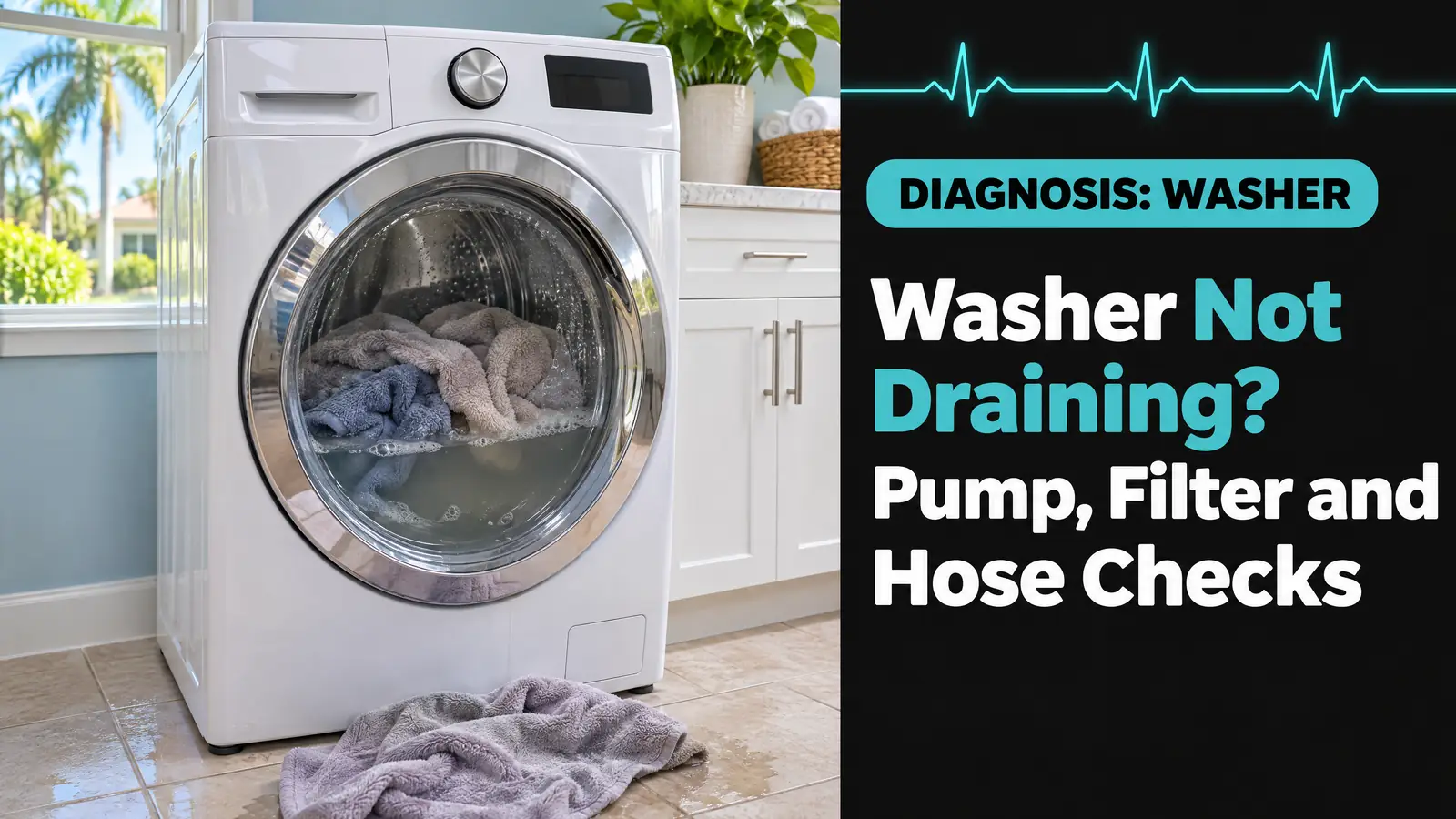
A washer that isn’t draining is most often blocked between the tub and the house drain: a clogged pump filter, a kinked or badly placed drain hose, or a standpipe that is itself clogged. After those come too many suds, a lid switch that won’t confirm the lid is closed, and a failed drain pump. Here is how to find out which one you have, in the order a technician checks, and what each repair costs.
Quick diagnosis
- Wait three minutes first. GE says pauses of up to 3 minutes between cycles are normal on many models, so a quiet tub full of water isn’t always a fault.
- Front-loader? The pump filter behind the small door at the bottom front is the most common blockage. Coins, hair ties and lint collect there.
- Water drains while the washer is still filling? That’s siphoning, an installation problem with the drain hose, not a broken part.
- Tub full and the washer just hums? GE’s guidance is to book service: the pump is jammed or has failed.
- Drain pump replacement runs $150 to $350 (HomeGuide) or $300 to $400 (Fixr).
Triage
- Stop using it now: water spreading toward an outlet or power strip, a burning smell, or a breaker that trips. Unplug the washer if you can reach the plug from a dry spot; if not, switch off its breaker.
- Book a technician: a humming or buzzing sound with a full tub, a grinding pump, or a washer that still won’t drain after the hose, filter and standpipe checks below.
- Safe to check yourself: the pause, the cycle you picked, detergent, the drain hose and how it sits in the standpipe, a front-loader’s pump filter, and whether the house drain takes water.
Symptom checker: what the washer is doing tells you where to look
Note how much water is left and what you hear before you take anything apart.
| What you notice | Most likely cause | Who fixes it |
|---|---|---|
| Full tub, washer silent for a minute or two | A normal pause between cycles | Nobody: wait 3 minutes |
| Full tub, pump runs but the water level barely drops | Clogged pump filter, kinked hose, clogged standpipe | You first; a plumber if the standpipe won’t take water |
| Full tub, low hum or buzz, no water movement | Drain pump jammed by an object or failed | Technician |
| Full tub, total silence, lid or door closed | Lid switch or door lock, control board | Technician |
| Drains slowly, then stops with an error | Partial clog, drain too high, too much detergent foam | You (hose, suds, filter) |
| Drains while it fills, never reaches the right level | Siphoning: hose pushed too deep or sealed in the pipe | You (hose position or anti-siphon clip) |
| Water backs up out of the standpipe or a nearby floor drain | House drain or septic problem, not the washer | Plumber or septic contractor |
Check these first (no tools needed)
Do these in order: each one rules out something cheaper than the next.
Before you touch anything
- Unplug the washer before you pull it out, reach into the tub, or open the pump filter door.
- After a hot or sanitize cycle, Samsung says to let the water cool for about an hour before you drain it by hand.
- Expect water on the floor. Lay down old towels and have a shallow pan ready; a front-loader can hold several gallons.
- Never force a locked front-load door or tape down a lid switch. A door that stays locked is a job for the technician.
- Give it 3 minutes. GE notes that many washers pause for up to 3 minutes between cycles. On a dial model, don’t turn the dial forward during a pause: GE warns that advancing it by hand can skip the pump-out part of the cycle.
- Check the lid and the cycle. On a top-loader, close the lid. GE says washers from 1994 or earlier must have the lid down to drain, and on newer models the lid switch still has to confirm it’s closed before the spin-drain. Gentle and delicate cycles use slow spins, so Whirlpool says they leave more water in the clothes; that’s normal, not a fault.
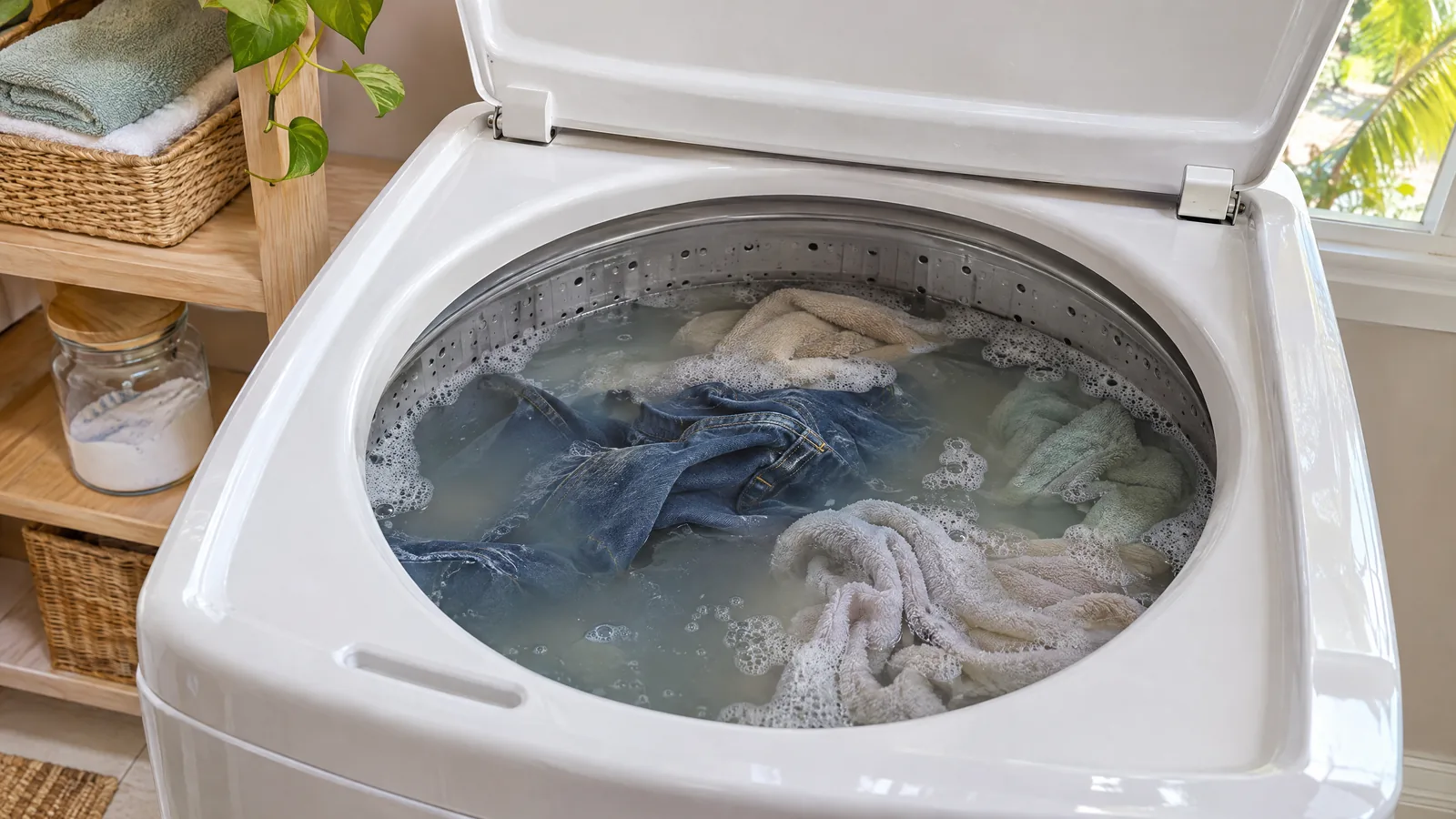
- Look for suds. Whirlpool says too much detergent can create enough suds to stop the washer from pumping water out. Use HE detergent at the measured dose and run a rinse to clear the foam.
- Follow the drain hose. Pull the washer out a few inches and look along the hose for kinks, a flattened section where the washer was pushed against the wall, or a hose that’s been stretched. Whirlpool says to clear any blockage in the hose, drainpipe or utility sink and to secure the hose with its U-shaped form.
- Test the house drain. This is the step most guides skip. Lift the hose out of the standpipe and pour about a quart of water into the pipe, as GE suggests. If it backs up or drains very slowly, the clog is in the house plumbing and GE recommends a plumber. The washer may be fine.
- Clean the pump filter (front-loaders). See the next section for how.
- Run a test cycle. Plug the washer back in and run a Rinse and Spin or Drain and Spin cycle with the tub empty. Samsung says the washer should start draining at the beginning of the test cycle. If it doesn’t, the problem is inside the machine.
Why is my washer not draining all the way?
When a washer drains part of the water and leaves the rest, the pump works but something slows the flow: a partly blocked pump filter, a soft kink in the hose, a drain that’s too high, or foam. The control eventually gives up and stops the cycle or shows a drain error.
Clean the pump filter on a front-loader
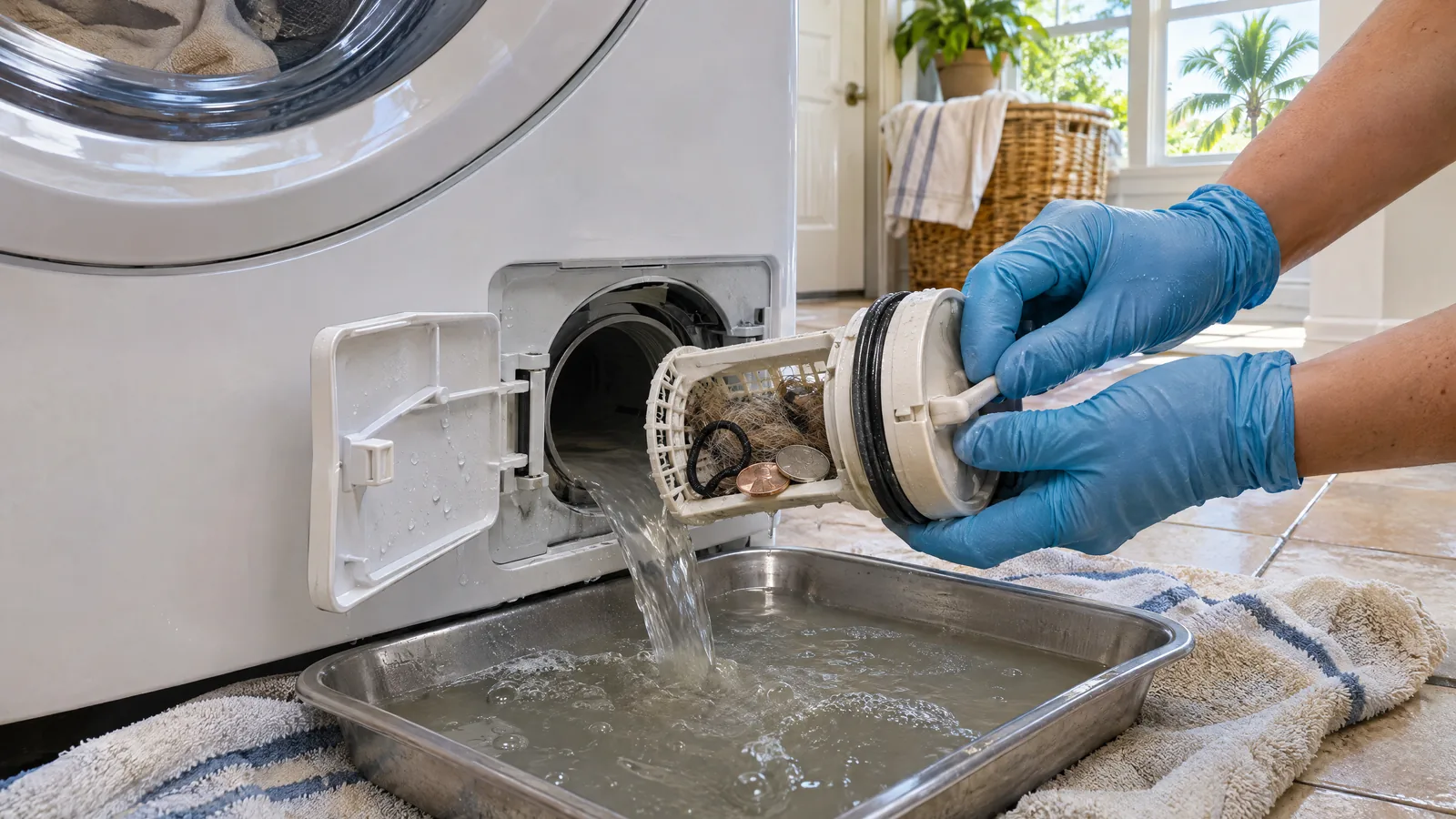
GE explains that small items from pockets get past the drum and into the drain system, and the filter is there to catch them before they reach your plumbing. Once enough collects, the same filter slows or stops the drain. Samsung says this step applies to front-loaders only, because its top-loaders have no removable pump filter, so check your manual before you go looking for one.
- Unplug the washer and put towels and a shallow pan under the small access door at the bottom front.
- Open the door. Many models have a short drain tube next to the filter: pull it out, uncap it over the pan and let the water run out slowly.
- When the flow stops, turn the filter cap counterclockwise and pull it out. More water will come out.
- Clear coins, hair ties, lint and buttons, rinse the filter, and look into the opening for anything still caught near the pump.
- Screw the filter back in until it’s tight, close the tube, and run a short rinse to check for leaks around the cap.
Check how high the drain is
Drain pumps push water up to the standpipe, and they have a limit. GE says most of its full-size washers can pump up to 8 feet above the floor, compact and portable models only 5 feet. Whirlpool lists a 96-inch (244 cm) maximum standpipe height. GE also gives flow numbers you won’t find on repair blogs: its top-load pump moves about 15 gallons a minute, its front-load pump about 10, and every extra foot of drain height cuts that by about 1 gallon a minute. A weak pump on a high drain may not finish in the time the control allows.
Technician’s note
On GE top-loaders made in 2015 and later, a flashing RINSE light or “Po” scrolling on the display means the washer took too long to pump out, according to GE. Treat it as a drain-path clue, not a board failure: check for a pinched hose and a slow standpipe before anything else.
Why does my washer drain while it’s filling?
If water runs out of the drain hose while the washer is still filling, the hose is siphoning, so the tub never reaches the right level. It’s almost always how the hose sits in the standpipe, which is why it shows up on newly installed washers. GE’s installation rules spell out what to check:
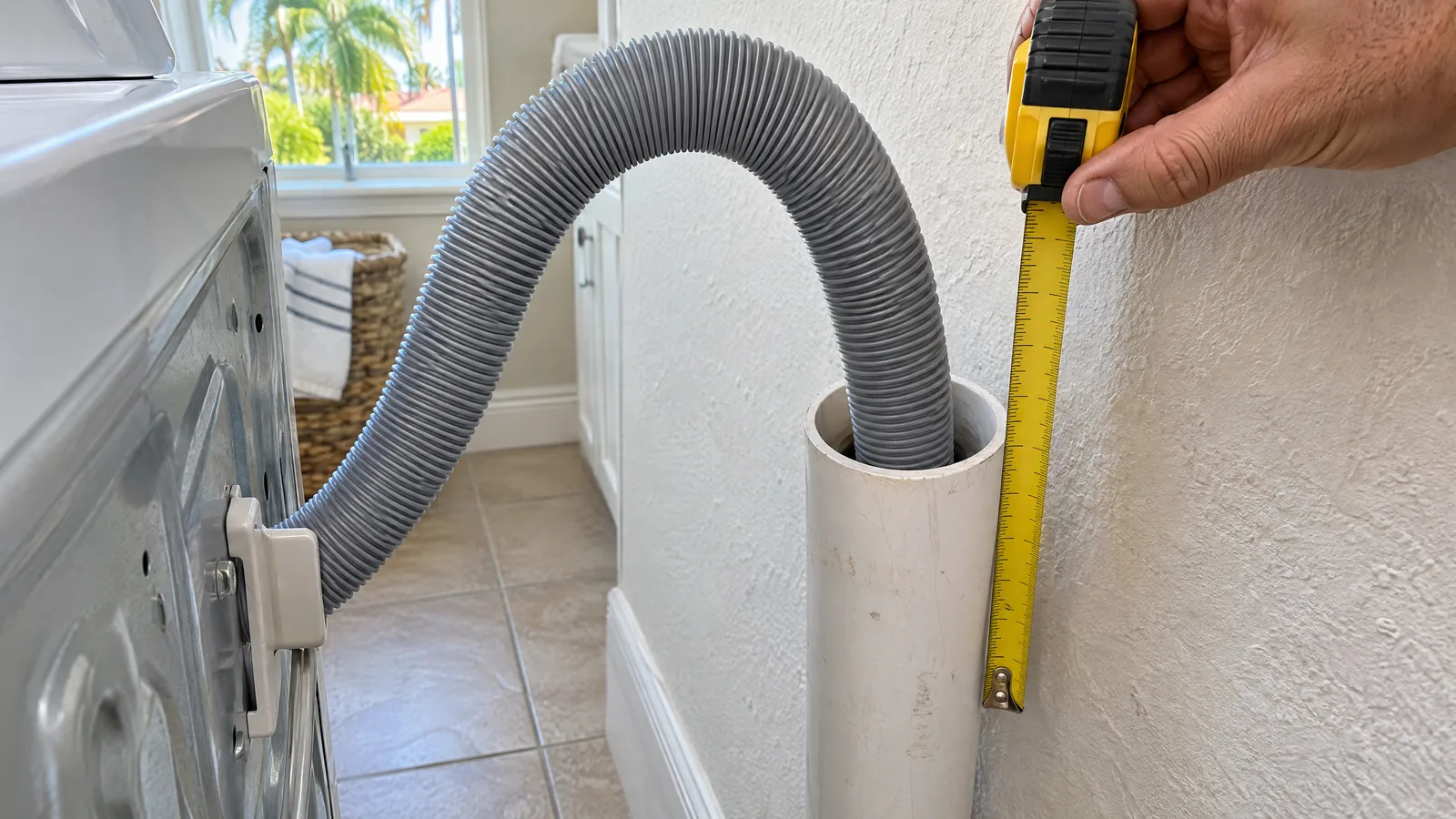
- The drain should be at least 30 inches above the floor for a top-loader and at least 24 inches for a front-loader. Whirlpool also gives 30 inches (76.2 cm) as its minimum.
- Push the hose no more than about 5 inches into the pipe on a top-loader and 7 inches on a front-loader. Deeper than that invites siphoning.
- Leave an air gap. GE notes the standpipe should be at least 1-1/2 inches inside diameter while the hose is about 1-1/4 inches outside, so air can get around it. Never tape or seal the hose into the pipe.
- If the drain is lower than 30 inches, use the drain hose clip (GE calls it an anti-siphon clip) that came with the washer to lift the hose higher at the back of the machine.
Samsung adds one more: don’t remove the screw that holds the drain hose holder to the back of the washer. If it’s missing, put the holder back with any screw that fits.
If the filter is clean, the hose is straight and the standpipe takes a quart of water without backing up, but the washer still won’t drain, the problem is a part. That’s the point to book a technician rather than keep restarting the cycle.
Why is my washer not draining when there’s no blockage?
When the drain path is clear and the washer still holds water, one of four parts is usually responsible, in this order.
Drain pump jammed or failed
The most common internal cause. A sock or a coin that slipped past the filter can lock the impeller, or the pump motor itself wears out. How a technician confirms it: with the tub full and the washer calling for a drain, a low hum with no water movement means the pump is getting power but can’t turn; GE says a washer with a full tub that just hums needs service. Silence means the pump isn’t getting power, which points back to the lid switch, door lock or control. A technician then checks the pump’s resistance and looks into the housing for debris. Replacement runs $150 to $350 according to HomeGuide and $300 to $400 according to Fixr, which also lists a Samsung washer pump at around $315.
Lid switch or door lock
Many washers won’t move to the spin-drain until the lid switch or door lock tells the control the washer is closed. How a technician confirms it: the washer agitates or tumbles fine, then stops with a full tub and no pump sound; the lock may click repeatedly, or the display may show a lid or lock code. The switch is tested for continuity with the lid closed. HomeGuide puts lid switch and lock repairs at $100 to $300, and Fixr starts lid switch fixes at about $85.
Drain hose clogged inside
A hose can look fine and still be packed with lint near the pump end; GE notes you may need to take it off the washer to find the clog. How a technician confirms it: water flows freely from the pump outlet with the hose removed. Fixr lists drain hose replacement at $95 to $170.
Control board or water level sensing
Less common. If the pump, switch and hose all test good, the control may not be sending the drain signal. How a technician confirms it: the washer’s service test mode, checking whether the pump gets voltage when called.
Does a septic system change why a Florida washer won’t drain?
It can. The Florida Department of Environmental Protection says septic systems handle wastewater for about 30% of Florida’s population, with an estimated 2.6 million systems in the state. In a home on septic, a standpipe that backs up during the drain, gurgling toilets or tubs when the washer empties, or a slow floor drain point to the septic system or the house line, not the washer. The quart-of-water test above is the quick way to tell.
The EPA’s septic care advice is to spread washing machine use through the week, because doing all the household laundry in one day can harm a septic system. If drain trouble only shows up on a heavy laundry day, that points at the house side: space the loads out, run the quart test, and call a septic contractor if the standpipe still backs up.
What does it cost to fix a washer that won’t drain?
Ranges from two cost guides; your price depends on the brand, the model and where the pump sits.
| Repair | HomeGuide | Fixr |
|---|---|---|
| Drain pump replacement | $150 to $350 | $300 to $400 |
| Lid switch or door lock | $100 to $300 | From about $85 |
| Drain hose replacement | Not listed | $95 to $170 |
| Typical washer repair overall | $100 to $400 | $150 to $400 |
| New washing machine | $700 to $1,300 | Not listed |
Prognosis: repair or replace?
- HomeGuide says a washer repair is usually worth it when the machine is under 7 years old and the repair costs less than 50% of a new washer. It puts a washer’s life at 8 to 13 years.
- Worked example (an illustration from those ranges, not a quote): a 5-year-old front-loader with a failed drain pump. Take the top of Fixr’s range, $400, against HomeGuide’s $700 to $1,300 for a new washer. Even against the cheapest new washer that’s 57%, but against a mid-range $1,000 machine it’s 40%, and the washer has years left. Repair it.
- A 12-year-old top-loader that needs a control board is near the end of that lifespan range: put the money toward a new washer.
When to call a technician
Call once the free checks are done and the tub still holds water, or straight away if the washer hums with a full tub or you smell burning. We repair washers across Tampa Bay, Orlando, Jacksonville and Sarasota, front-load and top-load, including Whirlpool, GE and Samsung. The technician diagnoses it, explains the repair and the price, and starts only once you approve. If you need the water out before the visit, our guide on how to drain a broken washing machine shows the safe way, and if it drains but won’t spin, see washer not spinning.
Frequently asked questions
Can I reset a washer that won’t drain?
There’s no universal drain reset. Unplugging the washer for a few minutes and running a Drain and Spin cycle can clear a stuck cycle, but it won’t clear a clogged filter, a kinked hose or a jammed pump. If the washer starts the test cycle and the water level doesn’t drop, Samsung’s guidance is to have it serviced.
Why is my new washer not draining?
With a new washer, look at the installation before the parts. The drain hose may be kinked behind the machine, pushed too far into the standpipe, sealed into it, or draining into a pipe that’s too high. GE’s limits are 30 inches minimum for a top-loader, no more than 5 to 7 inches of hose in the pipe, and an air gap around it.
Why is my washer not draining or spinning?
Because most washers won’t spin until the water is out. If the tub is full, treat it as a drain problem first: filter, hose, standpipe and suds. Once it drains, the spin usually comes back. If it drains but still won’t spin, the cause is a different part, such as the belt or the motor coupling.
Do top-load washers have a drain filter?
Many don’t have one you can reach. Samsung says its top-loaders have no removable pump filter. On a top-loader that won’t drain with a clear hose and a working standpipe, the pump itself is the usual suspect.
Appliance Doctor Pro
Washer still full of water?
Book a visit and a technician will find what’s blocking the drain, explain the repair and the price before starting, and back the repair with a 90-day warranty. Same-day and next-day appointments are available, 7 days a week.
General information for common washer designs. Your model’s manual has its exact cycles, codes and filter location. Unplug the washer before any check beyond the controls.
Sources
- GE Appliances: Top Load Washer, Will Not Drain
- GE Appliances: Front Load Washer, Will Not Drain or Drains Slowly
- GE Appliances: Washer, Drain Height
- GE Appliances: Top Load Washer, Fills and Drains at the Same Time
- Whirlpool Product Help: Washer Not Draining or Spinning? Troubleshooting Guide
- Samsung US Support: Samsung washing machine will not drain
- Florida Department of Environmental Protection: Onsite Sewage Program
- EPA: How to Care for Your Septic System
- HomeGuide: Washing Machine Repair Cost
- Fixr: Washing Machine Repair Cost